A retrofit de bateria solar significa adicionar armazenamento de bateria aos painéis solares que você já possui. Em muitos casos, você pode manter os painéis. Se você pode manter o inversor requer um pouco mais de verificação.
É uma situação familiar: seus painéis estão ocupados na hora do almoço enquanto você está fora. Quando você chega em casa, prepara o jantar e liga a televisão, você está comprando eletricidade da rede novamente.
Uma bateria pode salvar parte da energia solar do dia para mais tarde. Mas antes de escolher uma, aqui estão sete coisas que vale a pena verificar.
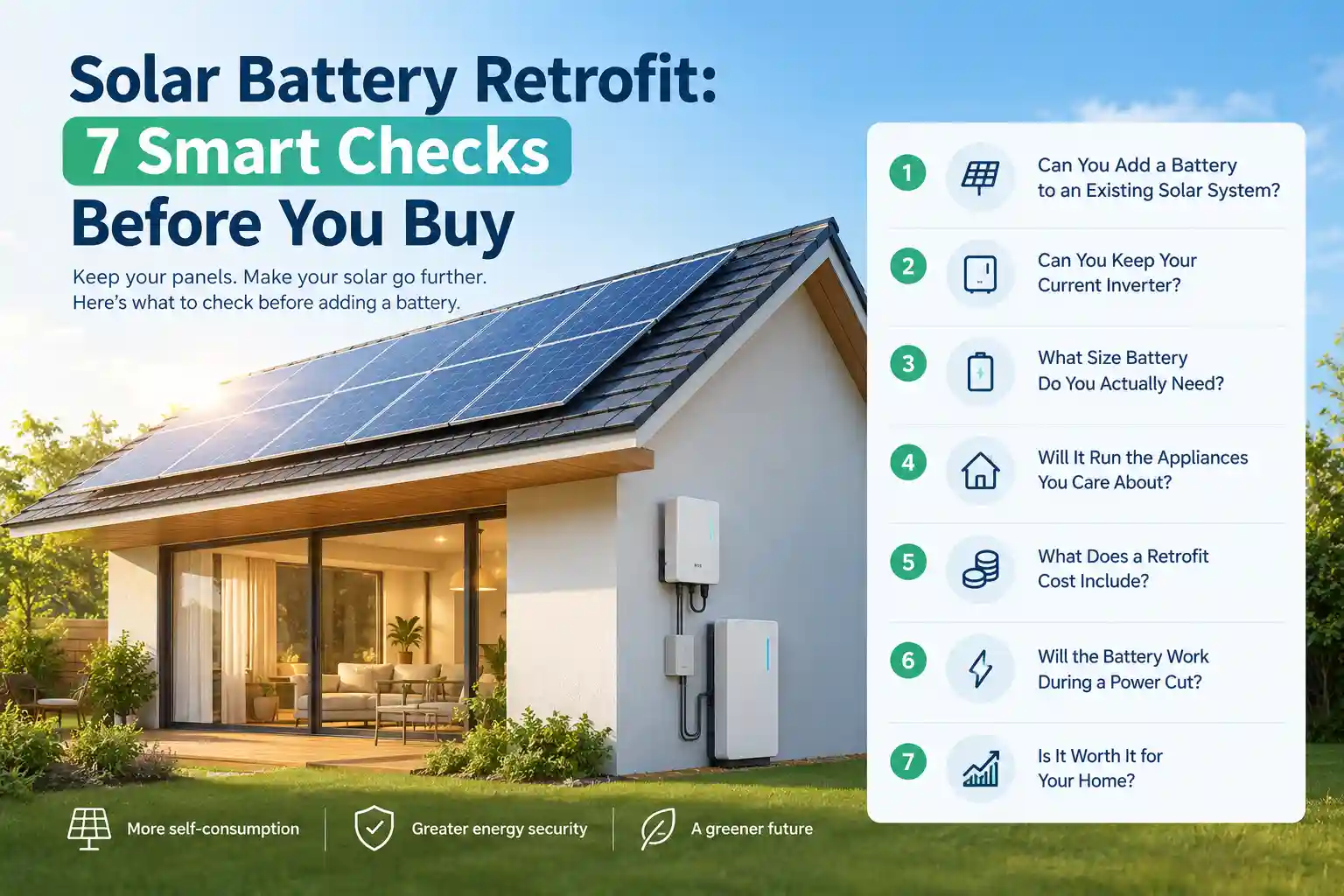
1. Você Pode Adicionar uma Bateria a um Sistema Solar Existente?
Normalmente, sim—desde que o equipamento e a instalação suportem isso. Você não precisa necessariamente começar do zero.
Existem três rotas comuns:
| O que você tem agora | Próximo passo possível |
|---|
| Um inversor híbrido pronto para bateria | Adicione uma bateria aprovada para esse modelo exato |
| Um inversor solar padrão | Mantenha-o e adicione equipamento de bateria AC acoplado adequado |
| Um inversor que precisa ser substituído | Considere um inversor híbrido compatível e bateria juntos |
Um sistema AC acoplado usa um inversor de bateria separado ou embutido conectado no lado AC da sua instalação. Isso pode permitir que seu equipamento solar existente permaneça no lugar. O guia de energia solar e bateria da Enphase explica a abordagem.
Uma configuração DC acoplada normalmente usa um inversor híbrido compatível. De qualquer forma, um inversor solar padrão não pode simplesmente carregar qualquer bateria que você conecte a ele.
2. Você Pode Manter Seu Inversor Atual?
Comece com uma foto da sua etiqueta. O modelo exato importa mais do que a marca.
Mesmo um inversor descrito como “pronto para bateria” pode suportar apenas certas baterias. Peça ao seu instalador para verificar voltagem, limites de carga, requisitos de comunicação e firmware.
Para uma atualização AC acoplada, a bateria deve corresponder ao seu inversor de bateria, e todo o arranjo deve funcionar com seu sistema solar existente.
Também pergunte se as mudanças afetam sua garantia atual. Uma verificação de cinco minutos é preferível a uma surpresa cara.
Nosso guia de compatibilidade de bateria e inversor explica os detalhes.
3. Qual o Tamanho de Bateria Que Você Realmente Precisa?
Antes de comparar baterias, abra seu aplicativo de monitoramento solar. Procure quanto de eletricidade você exporta durante o dia e quanto compra após o pôr do sol.
Aqui está um exemplo ilustrativo:
| Leitura diária | Example |
|---|
| Surplus solar exported | 7kWh |
| Evening electricity use | 5kWh |
| Starting point for assessment | Storage capable of delivering around 5kWh to evening loads |
That does not automatically mean buying a battery labelled “5kWh.”
Nominal capacity is the headline figure. Usable capacity reflects the manufacturer’s operating limits. Inverter losses and any backup reserve further affect what reaches your appliances. Don’t deduct the same discharge allowance twice if it is already included in usable capacity.
Check different seasons, too. A sunny July afternoon won’t tell you much about a cloudy winter week.
Nosso home battery sizing guide can help you work through the numbers.
4. Will It Run the Appliances You Care About?
Capacity and power are different things.
kWh tells you how much energy is stored. kW tells you how quickly the system can supply it.
A battery might hold enough energy for an evening but still be unable to run the oven, kettle and other large appliances together.
Give your installer a list of what you want to run. Ask about continuous output and the extra power some appliances need when starting.
5. What Does a Solar Battery Retrofit Cost Include?
The battery price is only part of the bill. Ask for an itemised quotation covering:
- Battery and usable capacity.
- Additional or replacement inverter.
- Controls, metering and electrical protection.
- Installation and any switchboard work.
- Backup equipment, if requested.
- Delivery, taxes and applicable approvals.
Energy Saving Trust’s battery storage guide provides useful background, although its pricing and local recommendations apply to the UK.
You can also review the Fench Energy 51.2V 5.12kWh LiFePO4 solar battery when comparing equipment. Its nominal capacity does not confirm compatibility, and the battery price is not a complete installation quote.
6. Will the Battery Work During a Power Cut?
Not automatically. Some installations store solar energy for everyday use but provide no backup.
Ordinary grid-connected solar generally shuts down during an outage to avoid feeding electricity into the disconnected grid. Backup requires a suitable system design, which may include switching equipment, a dedicated backup output and selected circuits.
Ask two questions: “Which appliances will stay on?” quanto do “Can the solar panels recharge the battery while the grid is down?”
Victron’s storage-system documentation illustrates why the answer depends on how the system is arranged.
7. Is a Solar Battery Retrofit Worth It for Your Home?
It deserves a closer look if you export plenty of daytime solar for little payment, then buy electricity at a higher price in the evening.
If you already use most of your solar directly, there is less surplus to store.
Compare expected savings using your own electricity rates, export payments, storage losses and installed quotation. Backup may also matter to you, but treat that benefit separately from bill savings.
Before buying, send Fench Energy your inverter model, installation country and whether you want evening storage, backup, or both. Request the relevant specifications and compatibility confirmation, then have a qualified local installer review the complete upgrade.




 English
 Polish
 Romanian
 German
 Dutch
 French
 Bulgarian
 Croatian
 Greek
 Czech
 Danish
 Estonian
 Finnish
 Swedish
 Hungarian
 Irish
 Italian
 Latvian
 Lithuanian
 Luxembourgish
 Maltese
 Portuguese
 Slovak
 Slovenian
 Spanish