A retrofit de batería solar significa agregar almacenamiento de batería a los paneles solares que ya tienes. En muchos casos, puedes conservar los paneles. Si puedes conservar el inversor requiere un poco más de revisión.
Es una situación familiar: tus paneles están activos al mediodía mientras no estás. Para cuando llegas a casa, cocinas la cena y enciendes la televisión, vuelves a comprar electricidad de la red.
Una batería puede guardar parte de esa energía solar diurna para más tarde. Pero antes de elegir una, aquí hay siete cosas que vale la pena revisar.
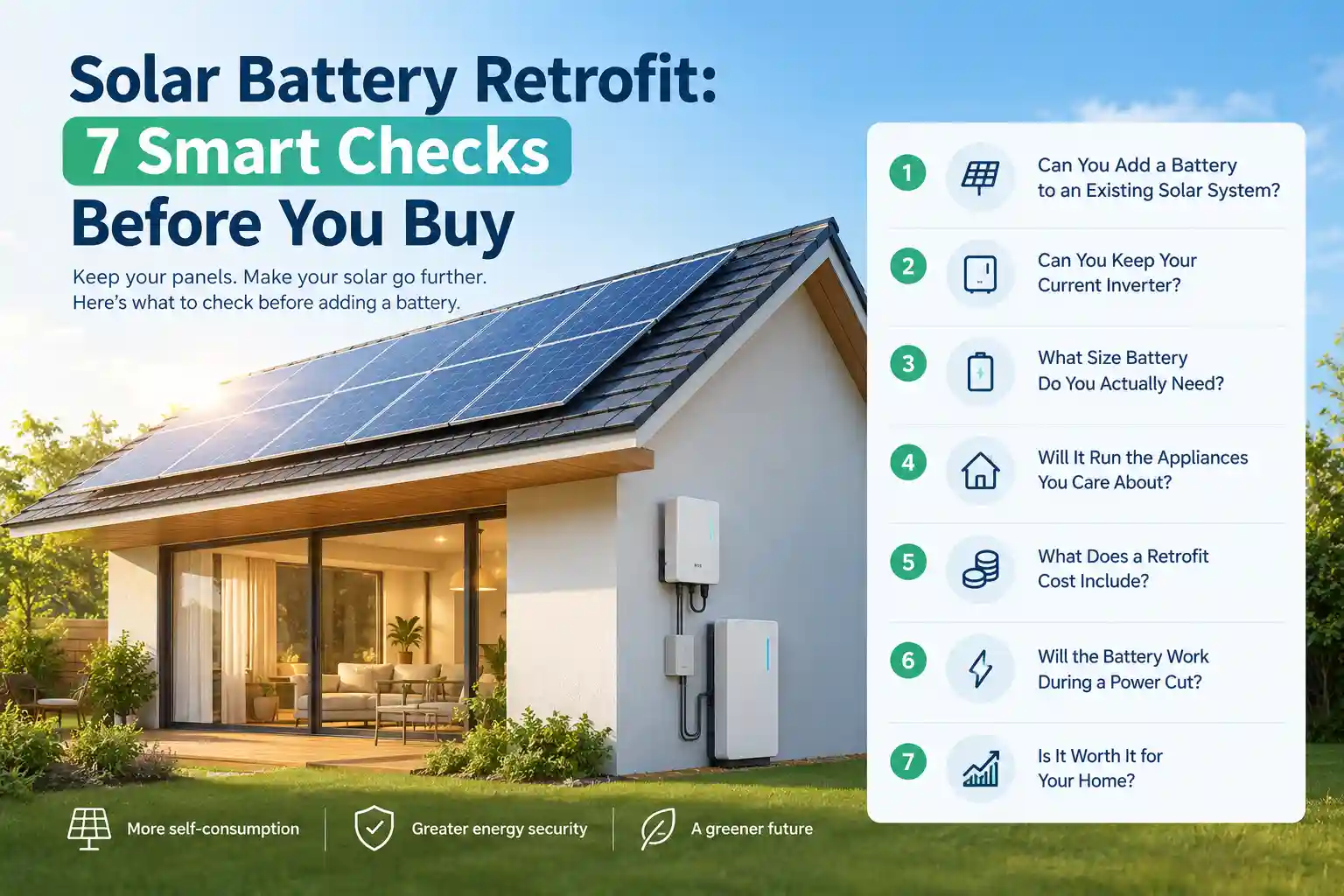
1. ¿Puedes agregar una batería a un sistema solar existente?
Generalmente, sí, siempre que el equipo y la instalación lo permitan. No necesariamente tienes que empezar de nuevo.
Hay tres rutas comunes:
| Lo que tienes ahora | Posible siguiente paso |
|---|
| Un inversor híbrido listo para batería | Agregar una batería aprobada para ese modelo exacto |
| Un inversor solar estándar | Conservarlo y agregar equipo de batería acoplado a CA adecuado |
| Un inversor que necesita ser reemplazado | Considerar un inversor híbrido compatible y batería juntos |
Un sistema acoplado a CA usa un inversor de batería separado o incorporado conectado en el lado de CA de tu instalación. Eso puede permitir que tu equipo solar existente permanezca en su lugar. La guía de energía solar y baterías de Enphase explica el enfoque.
Una configuración acoplada a CC comúnmente usa un inversor híbrido compatible. De cualquier manera, un inversor solar estándar no puede simplemente cargar cualquier batería que conectes a él.
2. ¿Puedes conservar tu inversor actual?
Comienza con una foto de su etiqueta. El modelo exacto importa más que la marca.
Incluso un inversor descrito como “listo para batería” puede soportar solo ciertas baterías. Pide a tu instalador que revise el voltaje, límites de carga, requisitos de comunicación y firmware.
Para una actualización acoplada a CA, la batería debe coincidir con su inversor de batería, y todo el arreglo debe funcionar con tu sistema solar existente.
También pregunta si los cambios afectan tu garantía actual. Una revisión de cinco minutos es preferible a una sorpresa costosa.
Nuestra guía de compatibilidad de baterías e inversores recorre los detalles.
3. ¿Qué tamaño de batería necesitas realmente?
Before comparing batteries, open your solar monitoring app. Look for how much electricity you export during the day and how much you buy after sunset.
Here’s an illustrative example:
| Daily reading | Example |
|---|
| Surplus solar exported | 7kWh |
| Evening electricity use | 5kWh |
| Starting point for assessment | Storage capable of delivering around 5kWh to evening loads |
That does not automatically mean buying a battery labelled “5kWh.”
Nominal capacity is the headline figure. Usable capacity reflects the manufacturer’s operating limits. Inverter losses and any backup reserve further affect what reaches your appliances. Don’t deduct the same discharge allowance twice if it is already included in usable capacity.
Check different seasons, too. A sunny July afternoon won’t tell you much about a cloudy winter week.
Nuestra home battery sizing guide can help you work through the numbers.
4. Will It Run the Appliances You Care About?
Capacity and power are different things.
kWh tells you how much energy is stored. kW tells you how quickly the system can supply it.
A battery might hold enough energy for an evening but still be unable to run the oven, kettle and other large appliances together.
Give your installer a list of what you want to run. Ask about continuous output and the extra power some appliances need when starting.
5. What Does a Solar Battery Retrofit Cost Include?
The battery price is only part of the bill. Ask for an itemised quotation covering:
- Battery and usable capacity.
- Additional or replacement inverter.
- Controls, metering and electrical protection.
- Installation and any switchboard work.
- Backup equipment, if requested.
- Delivery, taxes and applicable approvals.
Energy Saving Trust’s battery storage guide provides useful background, although its pricing and local recommendations apply to the UK.
You can also review the Fench Energy 51.2V 5.12kWh LiFePO4 solar battery when comparing equipment. Its nominal capacity does not confirm compatibility, and the battery price is not a complete installation quote.
6. Will the Battery Work During a Power Cut?
Not automatically. Some installations store solar energy for everyday use but provide no backup.
Ordinary grid-connected solar generally shuts down during an outage to avoid feeding electricity into the disconnected grid. Backup requires a suitable system design, which may include switching equipment, a dedicated backup output and selected circuits.
Ask two questions: “Which appliances will stay on?” y “Can the solar panels recharge the battery while the grid is down?”
Victron’s storage-system documentation illustrates why the answer depends on how the system is arranged.
7. Is a Solar Battery Retrofit Worth It for Your Home?
It deserves a closer look if you export plenty of daytime solar for little payment, then buy electricity at a higher price in the evening.
If you already use most of your solar directly, there is less surplus to store.
Compare expected savings using your own electricity rates, export payments, storage losses and installed quotation. Backup may also matter to you, but treat that benefit separately from bill savings.
Before buying, send Fench Energy your inverter model, installation country and whether you want evening storage, backup, or both. Request the relevant specifications and compatibility confirmation, then have a qualified local installer review the complete upgrade.




 English
 Polish
 Romanian
 German
 Dutch
 French
 Bulgarian
 Croatian
 Greek
 Czech
 Danish
 Estonian
 Finnish
 Swedish
 Hungarian
 Irish
 Italian
 Latvian
 Lithuanian
 Luxembourgish
 Maltese
 Portuguese
 Slovak
 Slovenian
 Spanish