A solar battery retrofit means adding battery storage to solar panels you already have. In many cases, you can keep the panels. Whether you can keep the inverter takes a little more checking.
It’s a familiar situation: your panels are busy at lunchtime while you’re out. By the time you get home, cook dinner and turn on the television, you’re buying electricity from the grid again.
A battery can save some of that daytime solar for later. But before choosing one, here are seven things worth checking.
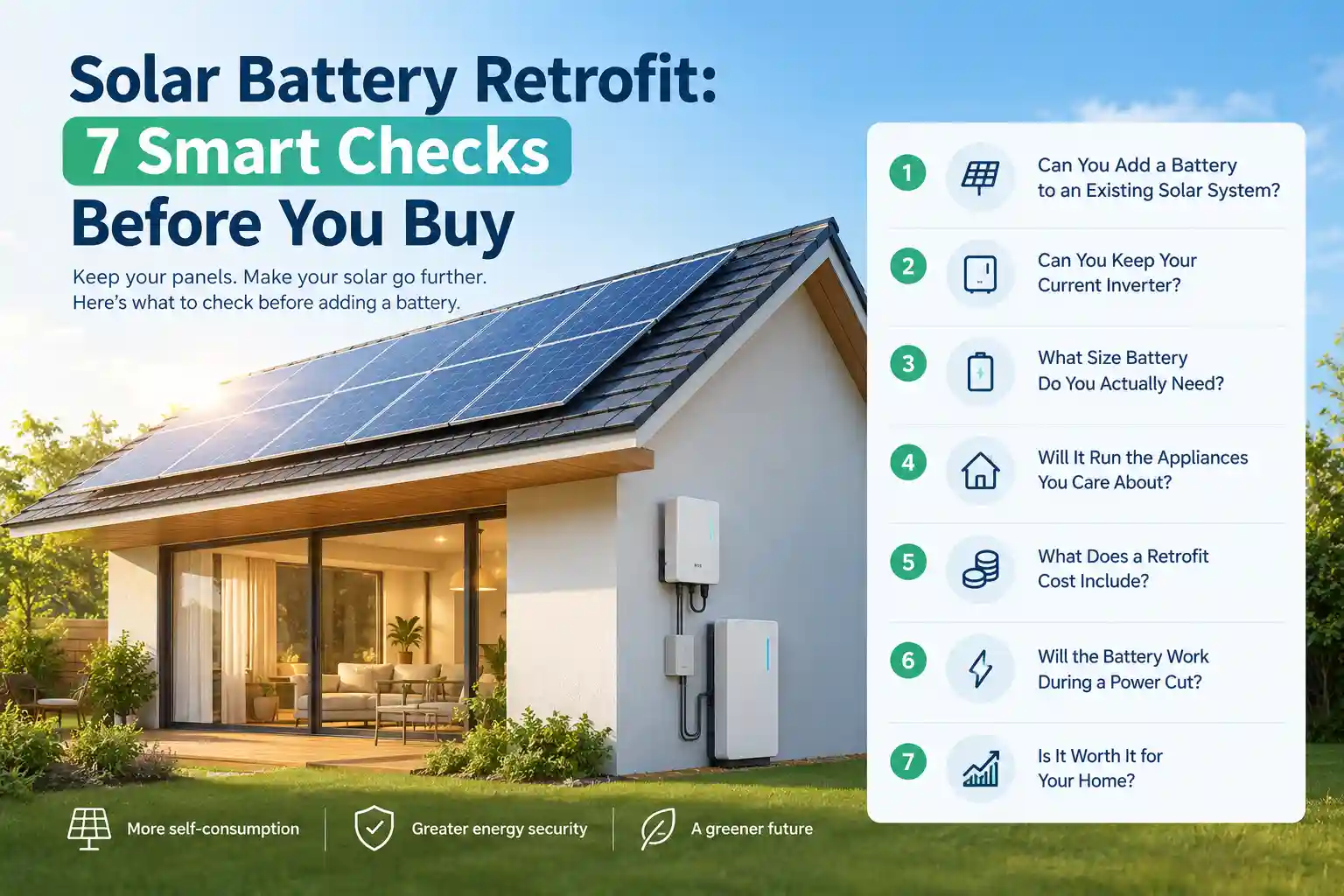
1. Can You Add a Battery to an Existing Solar System?
Usually, yes—provided the equipment and installation support it. You don’t necessarily need to start again.
There are three common routes:
| What you have now | Possible next step |
|---|
| A battery-ready hybrid inverter | Add a battery approved for that exact model |
| A standard solar inverter | Keep it and add suitable AC-coupled battery equipment |
| An inverter that needs replacing | Consider a compatible hybrid inverter and battery together |
An AC-coupled system uses a separate or built-in battery inverter connected on the AC side of your installation. That can let your existing solar equipment stay in place. Enphase’s solar and battery guide explains the approach.
A DC-coupled setup commonly uses a compatible hybrid inverter. Either way, a standard solar inverter cannot simply charge any battery you connect to it.
2. Can You Keep Your Current Inverter?
Start with a photo of its label. The exact model matters more than the brand.
Even an inverter described as “battery-ready” may only support certain batteries. Ask your installer to check voltage, charging limits, communication requirements and firmware.
For an AC-coupled upgrade, the battery must match its battery inverter, and the whole arrangement must work with your existing solar system.
Also ask whether the changes affect your current warranty. A five-minute check is preferable to an expensive surprise.
Notre battery and inverter compatibility guide walks through the details.
3. What Size Battery Do You Actually Need?
Before comparing batteries, open your solar monitoring app. Look for how much electricity you export during the day and how much you buy after sunset.
Here’s an illustrative example:
| Daily reading | Example |
|---|
| Surplus solar exported | 7kWh |
| Evening electricity use | 5kWh |
| Starting point for assessment | Storage capable of delivering around 5kWh to evening loads |
That does not automatically mean buying a battery labelled “5kWh.”
Nominal capacity is the headline figure. Usable capacity reflects the manufacturer’s operating limits. Inverter losses and any backup reserve further affect what reaches your appliances. Don’t deduct the same discharge allowance twice if it is already included in usable capacity.
Check different seasons, too. A sunny July afternoon won’t tell you much about a cloudy winter week.
Notre home battery sizing guide can help you work through the numbers.
4. Will It Run the Appliances You Care About?
Capacity and power are different things.
kWh tells you how much energy is stored. kW tells you how quickly the system can supply it.
A battery might hold enough energy for an evening but still be unable to run the oven, kettle and other large appliances together.
Give your installer a list of what you want to run. Ask about continuous output and the extra power some appliances need when starting.
5. What Does a Solar Battery Retrofit Cost Include?
The battery price is only part of the bill. Ask for an itemised quotation covering:
- Battery and usable capacity.
- Additional or replacement inverter.
- Controls, metering and electrical protection.
- Installation and any switchboard work.
- Backup equipment, if requested.
- Delivery, taxes and applicable approvals.
Energy Saving Trust’s battery storage guide provides useful background, although its pricing and local recommendations apply to the UK.
You can also review the Fench Energy 51.2V 5.12kWh LiFePO4 solar battery when comparing equipment. Its nominal capacity does not confirm compatibility, and the battery price is not a complete installation quote.
6. Will the Battery Work During a Power Cut?
Not automatically. Some installations store solar energy for everyday use but provide no backup.
Ordinary grid-connected solar generally shuts down during an outage to avoid feeding electricity into the disconnected grid. Backup requires a suitable system design, which may include switching equipment, a dedicated backup output and selected circuits.
Ask two questions: “Which appliances will stay on?” and “Can the solar panels recharge the battery while the grid is down?”
Victron’s storage-system documentation illustrates why the answer depends on how the system is arranged.
7. Is a Solar Battery Retrofit Worth It for Your Home?
It deserves a closer look if you export plenty of daytime solar for little payment, then buy electricity at a higher price in the evening.
If you already use most of your solar directly, there is less surplus to store.
Compare expected savings using your own electricity rates, export payments, storage losses and installed quotation. Backup may also matter to you, but treat that benefit separately from bill savings.
Before buying, send Fench Energy your inverter model, installation country and whether you want evening storage, backup, or both. Request the relevant specifications and compatibility confirmation, then have a qualified local installer review the complete upgrade.




 English
 Polish
 Romanian
 German
 Dutch
 French
 Bulgarian
 Croatian
 Greek
 Czech
 Danish
 Estonian
 Finnish
 Swedish
 Hungarian
 Irish
 Italian
 Latvian
 Lithuanian
 Luxembourgish
 Maltese
 Portuguese
 Slovak
 Slovenian
 Spanish