


Escolher uma bateria doméstica não é simplesmente uma questão de capacidade e preço. Se você já possui um inversor solar, a bateria também precisa corresponder aos requisitos elétricos e de comunicação do inversor.
Isso é particularmente importante ao adicionar uma bateria LiFePO4 a um sistema solar fotovoltaico existente. Dois produtos podem ser ambos descritos como “48V” ou “51.2V”, por exemplo, mas isso não significa necessariamente que eles possam se comunicar corretamente ou operar juntos.
Antes de encomendar uma bateria, há várias especificações que vale a pena verificar.
Por que a Compatibilidade da Bateria com o Inversor Solar é Importante?
O inversor e a bateria têm papéis diferentes, mas precisam trocar informações durante a operação normal. O BMS da bateria monitora parâmetros como tensão da célula, corrente da bateria e estado de carga (SOC), enquanto o inversor controla a carga e descarga de acordo com as informações disponíveis da bateria.
Se os dois dispositivos não estiverem devidamente compatíveis, o sistema pode apresentar falhas de comunicação, leituras incorretas de SOC, carga ou descarga restritas, ou desligamentos inesperados.
Por essa razão, a compatibilidade deve ser verificada tanto do lado elétrico quanto do lado da comunicação .
1. Verifique a Faixa de Tensão da Bateria
A tensão é uma das primeiras especificações a comparar.
Muitos sistemas residenciais de armazenamento usam uma bateria da classe 48V. Uma típica bateria LiFePO4 de 51,2V, por exemplo, usa 16 célulasconectadas em série, com uma tensão nominal por célula de 3,2V.
No entanto, a tensão nominal é apenas parte da questão. A faixa de tensão da bateria especificada pelo inversor também deve cobrir a tensão real de operação da bateria.
Ao comparar as duas folhas de dados, verifique:
- Tensão nominal da bateria
- Faixa de tensão de operação da bateria
- Tensão máxima de carga
- Corrente máxima de carga
- Corrente máxima de descarga
- Faixa de entrada da bateria do inversor
Uma bateria não deve ser selecionada apenas porque ambos os produtos estão rotulados como “48V”. As especificações elétricas do fabricante fornecem uma base muito mais confiável para a compatibilidade.
2. Verifique a Comunicação CAN ou RS485
Para muitos sistemas modernos de armazenamento de energia, a comunicação entre o BMS da bateria e o inversor é tão importante quanto a conexão elétrica.
CAN communication is widely used in battery energy storage systems. It allows the BMS to send information such as SOC, voltage, current and charge/discharge limits to the inverter.
RS485 is another common communication interface. Depending on the equipment, it may be used for BMS communication or other system functions.
Having the same physical interface, however, does not automatically guarantee compatibility. The devices also need to use a compatible communication protocol and configuration.
Before purchasing, check:
- Which communication interface the inverter requires
- Which interface the battery BMS supports
- Whether the inverter recognises the battery’s BMS protocol
- Whether a specific communication cable or pinout is required
- Whether additional inverter or BMS settings are needed
If the manufacturer provides a battery compatibility list, this is usually the best place to start.
3. Check the Exact Inverter Model
Do not rely on the inverter brand alone.
Deye, Victron Energy, Growatt, SMA, GoodWe and MUST all offer different inverter models, and the supported battery types, communication methods and configuration options can vary between models.
For example, knowing that a system uses a Deye inverter is useful, but the exact model number is normally needed for a proper compatibility check.
Before buying a battery, record the:
- Inverter manufacturer
- Exact model number
- Battery voltage range
- Maximum charge and discharge current
- Supported communication interfaces
- Compatible battery or BMS protocols
The inverter’s user manual or official compatibility documentation should be treated as the primary reference.
4. Read the Battery Datasheet Carefully
A good battery datasheet should provide enough technical information for a basic compatibility assessment.
Pay particular attention to:
- Voltagem nominal
- Rated capacity
- Operating voltage
- Maximum continuous charge current
- Maximum continuous discharge current
- Communication interface
- BMS information
- Operating temperature
- Supported inverter protocols or compatible inverter list
If the battery manufacturer only states that a battery is “compatible with solar inverters” without explaining the supported communication interfaces or protocols, it is worth asking for more detailed documentation.
For a home energy storage system, clear technical documentation is often a better indication of product quality than a long list of marketing features.
5. Confirm the Battery and Inverter Current Limits
Current ratings are sometimes overlooked when comparing batteries.
The inverter has a maximum charging and discharge current, while the battery and its BMS also have their own limits. The system should be configured within the limits specified by the manufacturers.
For example, a battery with a high capacity does not automatically mean that it can deliver unlimited power. The available output power depends on factors including battery voltage, current limits and BMS protection settings.
This is particularly relevant when selecting a larger home battery for a high-power inverter.
A Practical Compatibility Check Before Buying
Before placing an order, confirm these points with the inverter and battery documentation:
- Is the battery voltage within the inverter’s supported range?
- Are the battery’s charge and discharge current limits suitable?
- Does the inverter support the battery’s communication interface?
- Is the BMS communication protocol supported?
- Is the required communication cable or pinout specified?
- Is the exact inverter model included in the compatibility information?
If any of these points are unclear, it is better to confirm them with the battery or inverter manufacturer before installation.
Frequently Asked Questions
Can any 51.2V LiFePO4 battery work with a solar inverter?
No. A 51.2V nominal battery may be electrically suitable for a 48V-class system, but the inverter must also support the battery’s operating voltage, current limits and, where required, BMS communication protocol.
How do I check whether my inverter is compatible with a home battery?
Start with the inverter’s exact model number and compare its battery voltage range, current limits, communication interface and supported battery protocols with the battery manufacturer’s datasheet or compatibility list.
Final Thoughts
Checking compatibilidade da bateria do inversor solar before buying can prevent many of the problems that only become apparent during installation.
For an existing solar PV system, start with the inverter model and technical documentation. Then compare the battery voltage range, charge and discharge limits, CAN or RS485 interface and BMS communication requirements.
If you are considering a Fench Energy LiFePO4 home battery, providing the exact inverter model before purchase is the most reliable way to determine whether the battery is suitable for your system. Where compatibility depends on a specific communication protocol or configuration, technical confirmation is preferable to relying on the battery’s nominal voltage alone.
Battery Backup for Refrigerator: What Size Do You Need?
A battery backup for refrigerator use must do two jobs: start the compressor and keep the fridge running through an
LiFePO4 vs Lead Acid for Solar: Is Upgrading Worth It?
Comparing LiFePO4 vs lead acid for solar usually starts with a practical problem: your batteries no longer last through the
Can You Install a Home Battery in an Unheated Garage?
Installing a home battery in a garage can make sense. It keeps the equipment out of your living space, and
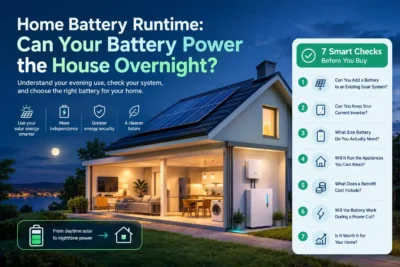
Duração da bateria doméstica: Sua bateria pode alimentar a casa durante a noite?
Home battery runtime depends on how much usable energy you have and what you run. A battery may keep the

Retrofit de bateria solar: 7 verificações inteligentes antes de comprar
A solar battery retrofit means adding battery storage to solar panels you already have. In many cases, you can keep

Is a 5kWh Home Battery Enough? 5 Essential Checks Before Buying
A 5kWh home battery can cover modest evening electricity use or keep selected essentials running during a power cut. Whether
 English
 Polish
 Romanian
 German
 Dutch
 French
 Bulgarian
 Croatian
 Greek
 Czech
 Danish
 Estonian
 Finnish
 Swedish
 Hungarian
 Irish
 Italian
 Latvian
 Lithuanian
 Luxembourgish
 Maltese
 Portuguese
 Slovak
 Slovenian
 Spanish