


Ní hamháin go mbaineann roghnú ceallraí baile le cumas agus praghas. Má tá inverter gréine agat cheana féin, ní mór don cheallraí freastal ar riachtanais leictreach agus cumarsáide an inverter freisin.
Tá sé seo tábhachtach go háirithe nuair a chuirtear ceallraí LiFePO4 leis an gcóras PV gréine atá ann cheana. D’fhéadfadh dhá tháirge a bheith curtha síos mar “48V” nó “51.2V”, mar shampla, ach ní chiallaíonn sin go gcaithfidh siad cumarsáid a dhéanamh i gceart nó oibriú le chéile.
Sula ndéanann tú ceallraí a ordú, tá roinnt sonraíochtaí atá fiúntach a sheiceáil.
Cén Fáth a bhfuil Comhoiriúnacht Ceallraí Inverter Gréine Tábhachtach?
Tá rólanna éagsúla ag an inverter agus an ceallraí, ach ní mór dóibh faisnéis a mhalartú le linn oibriú gnáth. Monatóireachtíonn BMS an cheallraí paraiméadair amhail voltais cille, reatha ceallraí agus staid luchtaithe (SOC), agus rialálann an inverter muirearú agus díluchtú de réir na faisnéise ceallraí atá ar fáil.
Mura bhfuil na dhá ghléas comhoiriúnach i gceart, d’fhéadfadh lochtanna cumarsáide, léamha SOC míchearta, muirearú nó díluchtú srianta, nó dúnadh neamhghnách a bheith sa chóras.
Ar an gcúis seo, ba chóir comhoiriúnacht a sheiceáil ó na leictreach agus cumarsáide taobhanna.
1. Seiceáil Raon Voltais an Cheallraí
Is é an voltais ceann de na sonraíochtaí is tábhachtaí le comparáid a dhéanamh orthu.
Úsáideann go leor córais stórála cónaithe ceallraí den rang 48V. Úsáideann ceallraí LiFePO4 tipiciúil 51.2V, mar shampla, 16 chillnascáilte i sraith, le voltais cille ainmniúil de 3.2V.
Mar sin féin, níl an voltais ainmniúil ach cuid den scéal. Ba cheart go gclúdódh raon voltais ceallraí sonraithe an inverter freisin an voltais oibriúcháin iarbhír den cheallraí.
Agus tú ag comparáid na dhá dhatasheet, seiceáil:
- Voltais ainmniúil an cheallraí
- Raon voltais oibriúcháin an cheallraí
- Voltais uasta muirearaithe
- Reatha uasta muirearaithe
- Reatha uasta díluchtaithe
- Raon ionchur ceallraí an inverter
Níor chóir ceallraí a roghnú díreach toisc go bhfuil lipéad “48V” ar an dá tháirge. Soláthraíonn sonraíochtaí leictreacha an mhonaróra bunús i bhfad níos iontaofa do chomhoiriúnacht.
2. Seiceáil Cumarsáid CAN nó RS485
I gcás go leor córais stórála fuinnimh nua-aimseartha, tá cumarsáid idir BMS an cheallraí agus an inverter chomh tábhachtach leis an nasc leictreach.
CAN communication is widely used in battery energy storage systems. It allows the BMS to send information such as SOC, voltage, current and charge/discharge limits to the inverter.
RS485 is another common communication interface. Depending on the equipment, it may be used for BMS communication or other system functions.
Having the same physical interface, however, does not automatically guarantee compatibility. The devices also need to use a compatible communication protocol and configuration.
Before purchasing, check:
- Which communication interface the inverter requires
- Which interface the battery BMS supports
- Whether the inverter recognises the battery’s BMS protocol
- Whether a specific communication cable or pinout is required
- Whether additional inverter or BMS settings are needed
If the manufacturer provides a battery compatibility list, this is usually the best place to start.
3. Check the Exact Inverter Model
Do not rely on the inverter brand alone.
Deye, Victron Energy, Growatt, SMA, GoodWe and MUST all offer different inverter models, and the supported battery types, communication methods and configuration options can vary between models.
For example, knowing that a system uses a Deye inverter is useful, but the exact model number is normally needed for a proper compatibility check.
Before buying a battery, record the:
- Inverter manufacturer
- Exact model number
- Battery voltage range
- Maximum charge and discharge current
- Supported communication interfaces
- Compatible battery or BMS protocols
The inverter’s user manual or official compatibility documentation should be treated as the primary reference.
4. Read the Battery Datasheet Carefully
A good battery datasheet should provide enough technical information for a basic compatibility assessment.
Pay particular attention to:
- Nominal voltage
- Rated capacity
- Operating voltage
- Maximum continuous charge current
- Maximum continuous discharge current
- Communication interface
- BMS information
- Operating temperature
- Supported inverter protocols or compatible inverter list
If the battery manufacturer only states that a battery is “compatible with solar inverters” without explaining the supported communication interfaces or protocols, it is worth asking for more detailed documentation.
For a home energy storage system, clear technical documentation is often a better indication of product quality than a long list of marketing features.
5. Confirm the Battery and Inverter Current Limits
Current ratings are sometimes overlooked when comparing batteries.
The inverter has a maximum charging and discharge current, while the battery and its BMS also have their own limits. The system should be configured within the limits specified by the manufacturers.
For example, a battery with a high capacity does not automatically mean that it can deliver unlimited power. The available output power depends on factors including battery voltage, current limits and BMS protection settings.
This is particularly relevant when selecting a larger home battery for a high-power inverter.
A Practical Compatibility Check Before Buying
Before placing an order, confirm these points with the inverter and battery documentation:
- Is the battery voltage within the inverter’s supported range?
- Are the battery’s charge and discharge current limits suitable?
- Does the inverter support the battery’s communication interface?
- Is the BMS communication protocol supported?
- Is the required communication cable or pinout specified?
- Is the exact inverter model included in the compatibility information?
If any of these points are unclear, it is better to confirm them with the battery or inverter manufacturer before installation.
Frequently Asked Questions
Can any 51.2V LiFePO4 battery work with a solar inverter?
No. A 51.2V nominal battery may be electrically suitable for a 48V-class system, but the inverter must also support the battery’s operating voltage, current limits and, where required, BMS communication protocol.
How do I check whether my inverter is compatible with a home battery?
Start with the inverter’s exact model number and compare its battery voltage range, current limits, communication interface and supported battery protocols with the battery manufacturer’s datasheet or compatibility list.
Final Thoughts
Checking comhoiriúlacht ceallraí inverter gréine before buying can prevent many of the problems that only become apparent during installation.
For an existing solar PV system, start with the inverter model and technical documentation. Then compare the battery voltage range, charge and discharge limits, CAN or RS485 interface and BMS communication requirements.
If you are considering a Fench Energy LiFePO4 home battery, providing the exact inverter model before purchase is the most reliable way to determine whether the battery is suitable for your system. Where compatibility depends on a specific communication protocol or configuration, technical confirmation is preferable to relying on the battery’s nominal voltage alone.
Battery Backup for Refrigerator: What Size Do You Need?
A battery backup for refrigerator use must do two jobs: start the compressor and keep the fridge running through an
LiFePO4 vs Lead Acid for Solar: Is Upgrading Worth It?
Comparing LiFePO4 vs lead acid for solar usually starts with a practical problem: your batteries no longer last through the
Can You Install a Home Battery in an Unheated Garage?
Installing a home battery in a garage can make sense. It keeps the equipment out of your living space, and
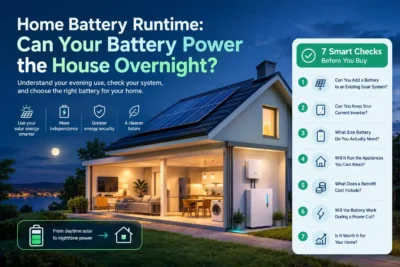
Home Battery Runtime: Can Your Battery Power the House Overnight?
Home battery runtime depends on how much usable energy you have and what you run. A battery may keep the

Solar Battery Retrofit: 7 Smart Checks Before You Buy
A solar battery retrofit means adding battery storage to solar panels you already have. In many cases, you can keep

Is a 5kWh Home Battery Enough? 5 Essential Checks Before Buying
A 5kWh home battery can cover modest evening electricity use or keep selected essentials running during a power cut. Whether
 English
 Polish
 Romanian
 German
 Dutch
 French
 Bulgarian
 Croatian
 Greek
 Czech
 Danish
 Estonian
 Finnish
 Swedish
 Hungarian
 Irish
 Italian
 Latvian
 Lithuanian
 Luxembourgish
 Maltese
 Portuguese
 Slovak
 Slovenian
 Spanish