


Choosing a home battery is not simply a matter of capacity and price. If you already have a solar inverter, the battery also needs to match the inverter’s electrical and communication requirements.
This is particularly important when adding a LiFePO4 battery to an existing solar PV system. Two products may both be described as “48V” or “51.2V”, for example, but that does not necessarily mean they can communicate correctly or operate together.
Before ordering a battery, there are several specifications worth checking.
Why Does Solar Inverter Battery Compatibility Matter?
The inverter and battery have different roles, but they need to exchange information during normal operation. The battery’s BMS monitors parameters such as cell voltage, battery current and state of charge (SOC), while the inverter controls charging and discharging according to the available battery information.
If the two devices are not properly matched, the system may experience communication faults, incorrect SOC readings, restricted charging or discharging, or unexpected shutdowns.
For this reason, compatibility should be checked from both the electrical and communication sides.
1. Check the Battery Voltage Range
Voltage is one of the first specifications to compare.
Many residential storage systems use a 48V-class battery. A typical 51.2V LiFePO4 battery, for example, uses 16 cells connected in series, with a nominal cell voltage of 3.2V.
However, the nominal voltage is only part of the picture. The inverter’s specified battery voltage range should also cover the battery’s actual operating voltage.
When comparing the two datasheets, check:
- Nominal battery voltage
- Battery operating voltage range
- Maximum charging voltage
- Maximum charge current
- Maximum discharge current
- Inverter battery input range
A battery should not be selected solely because both products are labelled “48V”. The manufacturer’s electrical specifications provide a much more reliable basis for compatibility.
2. Check CAN or RS485 Communication
For many modern energy storage systems, communication between the battery BMS and inverter is just as important as the electrical connection.
CAN communication is widely used in battery energy storage systems. It allows the BMS to send information such as SOC, voltage, current and charge/discharge limits to the inverter.
RS485 is another common communication interface. Depending on the equipment, it may be used for BMS communication or other system functions.
Having the same physical interface, however, does not automatically guarantee compatibility. The devices also need to use a compatible communication protocol and configuration.
Before purchasing, check:
- Which communication interface the inverter requires
- Which interface the battery BMS supports
- Whether the inverter recognises the battery’s BMS protocol
- Whether a specific communication cable or pinout is required
- Whether additional inverter or BMS settings are needed
If the manufacturer provides a battery compatibility list, this is usually the best place to start.
3. Check the Exact Inverter Model
Do not rely on the inverter brand alone.
Deye, Victron Energy, Growatt, SMA, GoodWe and MUST all offer different inverter models, and the supported battery types, communication methods and configuration options can vary between models.
For example, knowing that a system uses a Deye inverter is useful, but the exact model number is normally needed for a proper compatibility check.
Before buying a battery, record the:
- Inverter manufacturer
- Exact model number
- Battery voltage range
- Maximum charge and discharge current
- Supported communication interfaces
- Compatible battery or BMS protocols
The inverter’s user manual or official compatibility documentation should be treated as the primary reference.
4. Read the Battery Datasheet Carefully
A good battery datasheet should provide enough technical information for a basic compatibility assessment.
Pay particular attention to:
- Nominal voltage
- Rated capacity
- Operating voltage
- Maximum continuous charge current
- Maximum continuous discharge current
- Communication interface
- BMS information
- Operating temperature
- Supported inverter protocols or compatible inverter list
If the battery manufacturer only states that a battery is “compatible with solar inverters” without explaining the supported communication interfaces or protocols, it is worth asking for more detailed documentation.
For a home energy storage system, clear technical documentation is often a better indication of product quality than a long list of marketing features.
5. Confirm the Battery and Inverter Current Limits
Current ratings are sometimes overlooked when comparing batteries.
The inverter has a maximum charging and discharge current, while the battery and its BMS also have their own limits. The system should be configured within the limits specified by the manufacturers.
For example, a battery with a high capacity does not automatically mean that it can deliver unlimited power. The available output power depends on factors including battery voltage, current limits and BMS protection settings.
This is particularly relevant when selecting a larger home battery for a high-power inverter.
A Practical Compatibility Check Before Buying
Before placing an order, confirm these points with the inverter and battery documentation:
- Is the battery voltage within the inverter’s supported range?
- Are the battery’s charge and discharge current limits suitable?
- Does the inverter support the battery’s communication interface?
- Is the BMS communication protocol supported?
- Is the required communication cable or pinout specified?
- Is the exact inverter model included in the compatibility information?
If any of these points are unclear, it is better to confirm them with the battery or inverter manufacturer before installation.
Frequently Asked Questions
Can any 51.2V LiFePO4 battery work with a solar inverter?
No. A 51.2V nominal battery may be electrically suitable for a 48V-class system, but the inverter must also support the battery’s operating voltage, current limits and, where required, BMS communication protocol.
How do I check whether my inverter is compatible with a home battery?
Start with the inverter’s exact model number and compare its battery voltage range, current limits, communication interface and supported battery protocols with the battery manufacturer’s datasheet or compatibility list.
Final Thoughts
Checking solar inverter battery compatibility before buying can prevent many of the problems that only become apparent during installation.
For an existing solar PV system, start with the inverter model and technical documentation. Then compare the battery voltage range, charge and discharge limits, CAN or RS485 interface and BMS communication requirements.
If you are considering a Fench Energy LiFePO4 home battery, providing the exact inverter model before purchase is the most reliable way to determine whether the battery is suitable for your system. Where compatibility depends on a specific communication protocol or configuration, technical confirmation is preferable to relying on the battery’s nominal voltage alone.
Battery Backup for Refrigerator: What Size Do You Need?
A battery backup for refrigerator use must do two jobs: start the compressor and keep the fridge running through an
LiFePO4 vs Lead Acid for Solar: Is Upgrading Worth It?
Comparing LiFePO4 vs lead acid for solar usually starts with a practical problem: your batteries no longer last through the
Can You Install a Home Battery in an Unheated Garage?
Installing a home battery in a garage can make sense. It keeps the equipment out of your living space, and
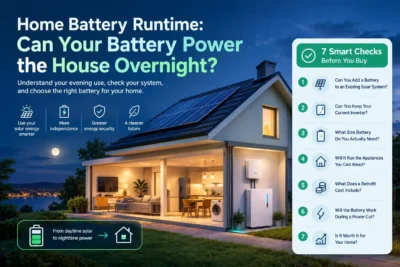
Home Battery Runtime: Can Your Battery Power the House Overnight?
Home battery runtime depends on how much usable energy you have and what you run. A battery may keep the

Solar Battery Retrofit: 7 Smart Checks Before You Buy
A solar battery retrofit means adding battery storage to solar panels you already have. In many cases, you can keep

Is a 5kWh Home Battery Enough? 5 Essential Checks Before Buying
A 5kWh home battery can cover modest evening electricity use or keep selected essentials running during a power cut. Whether
 English
 Polish
 Romanian
 German
 Dutch
Dutch French
 Bulgarian
 Croatian
 Greek
Greek Czech
Czech Danish
 Estonian
 Finnish
 Swedish
 Hungarian
 Irish
Irish Italian
 Latvian
 Lithuanian
 Luxembourgish
 Maltese
 Portuguese
 Slovak
 Slovenian
 Spanish