


Valg af hjemmebatteri handler ikke kun om kapacitet og pris. Hvis du allerede har en solinverter, skal batteriet også matche inverterens elektriske og kommunikationsmæssige krav.
Dette er især vigtigt, når man tilføjer et LiFePO4-batteri til et eksisterende solcelleanlæg. To produkter kan begge beskrives som “48V” eller “51,2V”, for eksempel, men det betyder ikke nødvendigvis, at de kan kommunikere korrekt eller fungere sammen.
Før du bestiller et batteri, er der flere specifikationer, der er værd at tjekke.
Hvorfor er kompatibilitet mellem solinverter og batteri vigtig?
Inverteren og batteriet har forskellige roller, men de skal udveksle information under normal drift. Batteriets BMS overvåger parametre som celle spænding, batteristrøm og opladningstilstand (SOC), mens inverteren styrer opladning og afladning baseret på den tilgængelige batteriinformation.
Hvis de to enheder ikke er korrekt matchet, kan systemet opleve kommunikationsfejl, forkerte SOC-aflæsninger, begrænset opladning eller afladning eller uventede nedlukninger.
Af denne grund bør kompatibilitet kontrolleres fra både elektrisk og kommunikations sider.
1. Tjek batteriets spændingsområde
Spænding er en af de første specifikationer at sammenligne.
Mange boliglagringssystemer bruger et 48V-klasse batteri. Et typisk 51,2V LiFePO4-batteri bruger for eksempel 16 cellerforbundet i serie, med en nominel cellespænding på 3,2V.
Den nominelle spænding er dog kun en del af billedet. Inverterens specificerede batterispændingsområde bør også dække batteriets faktiske driftsspænding.
Når du sammenligner de to datablad, skal du tjekke:
- Nominel batterispænding
- Batteriets driftsspændingsområde
- Maksimal opladningsspænding
- Maksimal opladningsstrøm
- Maksimal afladningsstrøm
- Inverterens batteriindgangsområde
Et batteri bør ikke vælges udelukkende fordi begge produkter er mærket “48V”. Producentens elektriske specifikationer giver et meget mere pålideligt grundlag for kompatibilitet.
2. Tjek CAN- eller RS485-kommunikation
For mange moderne energilagringssystemer er kommunikationen mellem batteriets BMS og inverteren lige så vigtig som den elektriske forbindelse.
CAN-kommunikation bruges bredt i batteri-energiproduktionssystemer. Det tillader BMS at sende information som SOC, spænding, strøm og opladnings-/afladningsgrænser til inverteren.
RS485 is another common communication interface. Depending on the equipment, it may be used for BMS communication or other system functions.
Having the same physical interface, however, does not automatically guarantee compatibility. The devices also need to use a compatible communication protocol and configuration.
Before purchasing, check:
- Which communication interface the inverter requires
- Which interface the battery BMS supports
- Whether the inverter recognises the battery’s BMS protocol
- Whether a specific communication cable or pinout is required
- Whether additional inverter or BMS settings are needed
If the manufacturer provides a battery compatibility list, this is usually the best place to start.
3. Check the Exact Inverter Model
Do not rely on the inverter brand alone.
Deye, Victron Energy, Growatt, SMA, GoodWe and MUST all offer different inverter models, and the supported battery types, communication methods and configuration options can vary between models.
For example, knowing that a system uses a Deye inverter is useful, but the exact model number is normally needed for a proper compatibility check.
Before buying a battery, record the:
- Inverter manufacturer
- Exact model number
- Battery voltage range
- Maximum charge and discharge current
- Supported communication interfaces
- Compatible battery or BMS protocols
The inverter’s user manual or official compatibility documentation should be treated as the primary reference.
4. Read the Battery Datasheet Carefully
A good battery datasheet should provide enough technical information for a basic compatibility assessment.
Pay particular attention to:
- Nominel Spænding
- Rated capacity
- Operating voltage
- Maximum continuous charge current
- Maximum continuous discharge current
- Communication interface
- BMS information
- Operating temperature
- Supported inverter protocols or compatible inverter list
If the battery manufacturer only states that a battery is “compatible with solar inverters” without explaining the supported communication interfaces or protocols, it is worth asking for more detailed documentation.
For a home energy storage system, clear technical documentation is often a better indication of product quality than a long list of marketing features.
5. Confirm the Battery and Inverter Current Limits
Current ratings are sometimes overlooked when comparing batteries.
The inverter has a maximum charging and discharge current, while the battery and its BMS also have their own limits. The system should be configured within the limits specified by the manufacturers.
For example, a battery with a high capacity does not automatically mean that it can deliver unlimited power. The available output power depends on factors including battery voltage, current limits and BMS protection settings.
This is particularly relevant when selecting a larger home battery for a high-power inverter.
A Practical Compatibility Check Before Buying
Before placing an order, confirm these points with the inverter and battery documentation:
- Is the battery voltage within the inverter’s supported range?
- Are the battery’s charge and discharge current limits suitable?
- Does the inverter support the battery’s communication interface?
- Is the BMS communication protocol supported?
- Is the required communication cable or pinout specified?
- Is the exact inverter model included in the compatibility information?
If any of these points are unclear, it is better to confirm them with the battery or inverter manufacturer before installation.
Frequently Asked Questions
Can any 51.2V LiFePO4 battery work with a solar inverter?
No. A 51.2V nominal battery may be electrically suitable for a 48V-class system, but the inverter must also support the battery’s operating voltage, current limits and, where required, BMS communication protocol.
How do I check whether my inverter is compatible with a home battery?
Start with the inverter’s exact model number and compare its battery voltage range, current limits, communication interface and supported battery protocols with the battery manufacturer’s datasheet or compatibility list.
Final Thoughts
Checking solcelleinverter batterikompatibilitet before buying can prevent many of the problems that only become apparent during installation.
For an existing solar PV system, start with the inverter model and technical documentation. Then compare the battery voltage range, charge and discharge limits, CAN or RS485 interface and BMS communication requirements.
If you are considering a Fench Energy LiFePO4 home battery, providing the exact inverter model before purchase is the most reliable way to determine whether the battery is suitable for your system. Where compatibility depends on a specific communication protocol or configuration, technical confirmation is preferable to relying on the battery’s nominal voltage alone.
Battery Backup for Refrigerator: What Size Do You Need?
A battery backup for refrigerator use must do two jobs: start the compressor and keep the fridge running through an
LiFePO4 vs Blysyre til solenergi: Er opgraderingen det værd?
Comparing LiFePO4 vs lead acid for solar usually starts with a practical problem: your batteries no longer last through the
Kan du installere et hjemmebatteri i en uopvarmet garage?
Installing a home battery in a garage can make sense. It keeps the equipment out of your living space, and
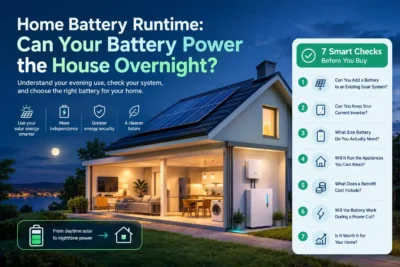
Hjemmebatteriets driftstid: Kan dit batteri forsyne huset natten over?
Home battery runtime depends on how much usable energy you have and what you run. A battery may keep the

Solbatteri retrofit: 7 smarte tjek før du køber
A solar battery retrofit means adding battery storage to solar panels you already have. In many cases, you can keep

Er et 5kWh hjemmebatteri nok? 5 vigtige tjek før køb
A 5kWh home battery can cover modest evening electricity use or keep selected essentials running during a power cut. Whether
 English
 Polish
 Romanian
 German
 Dutch
 French
 Bulgarian
 Croatian
 Greek
 Czech
 Danish
 Estonian
 Finnish
 Swedish
 Hungarian
 Irish
 Italian
 Latvian
 Lithuanian
 Luxembourgish
 Maltese
 Portuguese
 Slovak
 Slovenian
 Spanish