


Inhoudsopgave
LiFePO4 versus Lithium-Ion Batterijen: Volledige Vergelijking
LiFePO4 versus Lithium-Ion Batterijen: Volledige Vergelijking
Bij het kiezen van een batterij voor thuisback-up, opslag van zonne-energie of dagelijkse stroombehoeften, kunt u twee veelvoorkomende batterijtermen tegenkomen: LiFePO4-batterijen en lithium-ionbatterijen.
Beide technologieën behoren tot de lithiumbatterijfamilie, maar ze gebruiken verschillende chemische structuren en zijn ontworpen voor verschillende toepassingen.
Het belangrijkste verschil is dat LiFePO4-batterijen zich richten op veiligheid, lange levensduur en stabiele prestaties, terwijl veel traditionele lithium-ionbatterijen zich richten op hogere energiedichtheid en lichter gewicht.
Voor huiseigenaren die een batterijopslagsysteem kiezen, kan het begrijpen van de verschillen tussen LiFePO4- en lithium-ionbatterijen u helpen de juiste oplossing voor uw energiebehoeften te selecteren.
Wat is het verschil tussen LiFePO4- en lithium-ionbatterijen?
Allereerst is het belangrijk te begrijpen dat LiFePO4 eigenlijk een type lithium-ionbatterij is.
Lithium-ion is een algemene term die wordt gebruikt voor oplaadbare batterijen die lithiumionen gebruiken om energie op te slaan en vrij te geven. Verschillende batterijchemieën gebruiken verschillende materialen voor de kathode, wat invloed heeft op prestaties, veiligheid en levensduur.
Veelvoorkomende lithiumbatterijchemieën zijn onder andere:
- LiFePO4 (Lithiumijzerfosfaat)
- NMC (Nikkel Mangaan Kobalt)
- NCA (Nikkel Kobalt Aluminium)
Traditionele lithium-ionbatterijen zoals NMC en NCA worden veel gebruikt in:
- Smartphones
- Laptops
- Elektrische voertuigen
- Draagbare elektronica
LiFePO4-batterijen worden vaak gebruikt in:
- Thuisopslag van zonne-energie
- Back-up stroomvoorzieningssystemen
- Off-grid energiesystemen
- Residential battery storage
because of their excellent safety characteristics and long cycle life.
LiFePO4 vs Lithium-Ion Batteries: Quick Comparison
| Kenmerk | LiFePO4 Battery | Lithium-Ion Battery |
|---|---|---|
| Batterijtype | Lithium Iron Phosphate | Usually NMC/NCA chemistry |
| Lifespan | Longer cycle life | Generally shorter cycle life |
| Safety | Higher thermal stability | Good, but more sensitive to heat |
| Energiedichtheid | Lager | Higher |
| Gewicht | Heavier | Lighter |
| Charging Cycles | Thousands of cycles | Usually fewer cycles |
| Best Application | Home storage, solar, backup power | Portable devices, compact systems |
1. Lifespan and Cycle Life
One of the biggest advantages of LiFePO4-batterijen is their long service life.
A battery cycle refers to one complete charge and discharge process. The actual cycle life depends on many factors, including:
- Depth of discharge (DoD)
- Charging voltage
- Operating temperature
- Battery management system (BMS)
- Usage conditions
Many LiFePO4 batteries used in home energy storage are designed for thousands of charge cycles, with some products rated at 6,000–8,000+ cycles under specific testing conditions.
For homeowners using batteries every day with solar systems, longer cycle life can provide:
- Fewer battery replacements
- More stable long-term performance
- Better value over the lifetime of the system
2. Safety and Thermal Stability
Safety is one of the main reasons LiFePO4 batteries are popular for residential energy storage.
LiFePO4 chemistry has a stable crystal structure, which provides excellent thermal stability compared with many other lithium-ion chemistries.
This makes LiFePO4 a common choice for:
- Indoor home battery systems
- Solar energy storage
- Backup power applications
- Daily charging and discharging
However, battery safety depends on more than chemistry alone.
A reliable battery system should also include:
- Quality battery cells
- A proper Battery Management System (BMS)
- Temperature monitoring
- Over-charge protection
- Over-discharge protection
- Short-circuit protection
3. Energy Density and Weight
When comparing LiFePO4 vs lithium-ion batteries, traditional lithium-ion batteries usually have an advantage in energy density.
Higher energy density means more energy can be stored in a smaller and lighter battery package.
This is why lithium-ion batteries are widely used in:
- Mobile phones
- Laptops
- Elektrische voertuigen
- Portable power devices
LiFePO4 batteries are generally heavier and larger for the same energy capacity.
However, for fixed applications like home solar storage, weight is usually less important than:
- Battery lifespan
- Safety
- Reliability
- Long-term performance
4. Cost and Long-Term Value
The cheapest battery option is not always the lowest-cost solution over time.
When comparing batteries, homeowners should consider:
- Initial purchase price
- Expected lifespan
- Replacement cost
- Garantie
- Usable capacity
LiFePO4 batteries may have a higher upfront cost in some cases, but their longer lifespan and stable performance can provide better long-term value.
A battery that lasts longer and maintains performance over many years may reduce the need for early replacement.
5. LiFePO4 vs Lithium-Ion for Home Solar Storage
For home solar storage, batteries need to handle frequent charging and discharging.
A typical solar system may:
- Generate electricity during the day
- Store excess solar energy in the battery
- Use stored energy at night or during power outages
Because of this daily cycling pattern, homeowners usually prioritize:
- Long cycle life
- Safety
- Stable performance
- Reliable operation
LiFePO4 batteries are widely used in residential solar storage because they are designed for repeated daily cycling and long-term use.
Depth of Discharge (DoD) and Battery Life
Depth of Discharge (DoD) refers to how much of the battery capacity is used during each cycle.
For example:
- 50% DoD means half of the available energy is used
- 80% DoD means 80% of the energy is used
- 100% DoD means the full rated capacity is discharged
Operating conditions affect battery lifespan. Proper battery management, suitable charging settings, and reasonable DoD levels can help improve long-term battery performance.
Which Battery Should You Choose?
Choose LiFePO4 if you need:
- Home solar energy storage
- Backup power
- Long service life
- Daily charging and discharging
- High safety requirements
- Stable long-term performance
Choose traditional lithium-ion batteries if you need:
- Lightweight design
- Smaller size
- Higher energy density
- Portable applications
The best battery depends on your specific application and priorities.
What Should You Check Before Buying a Battery?
Before choosing a battery system, consider:
Capacity
How much energy can the battery store?
Usable Energy
Check usable capacity based on recommended DoD.
Cycli Levensduur
Understand the testing conditions behind cycle ratings.
Battery Safety
Look for proper protection features and certifications.
BMS Function
A reliable BMS helps monitor battery operation and protect the system.
Inverter Compatibility
Make sure the battery communication protocol matches your inverter.
Final Thoughts
When comparing LiFePO4 vs Lithium-Ion Batteries, both technologies have their own advantages.
Lithium-ion batteries are often selected when lightweight design and high energy density are the priority.
LiFePO4 batteries are commonly chosen for applications where safety, lifespan, and reliability are more important, especially in home solar storage and backup power systems.
For homeowners planning a long-term energy storage solution, understanding battery chemistry, capacity, cycle life, and system compatibility is the key to making the right choice.
FAQ
Is LiFePO4 better than lithium-ion batteries?
LiFePO4 is often preferred for home energy storage because of its long lifespan, safety characteristics, and stable performance.
Is LiFePO4 a lithium-ion battery?
Yes. LiFePO4 is one type of lithium-ion battery chemistry.
How long do LiFePO4 batteries last?
The lifespan depends on usage conditions, but many LiFePO4 batteries are designed for thousands of cycles, with some rated at 6,000–8,000+ cycles under specific test conditions.
Why are lithium-ion batteries lighter than LiFePO4 batteries?
Traditional lithium-ion chemistries generally have higher energy density, allowing them to store more energy in a smaller and lighter package.
Related Articles
Battery Backup for Refrigerator: What Size Do You Need?
A battery backup for refrigerator use must do two jobs: start the compressor and keep the fridge running through an
LiFePO4 versus loodzuur voor zonne-energie: is upgraden de moeite waard?
Comparing LiFePO4 vs lead acid for solar usually starts with a practical problem: your batteries no longer last through the
Kun je een thuisbatterij installeren in een onverwarmde garage?
Installing a home battery in a garage can make sense. It keeps the equipment out of your living space, and
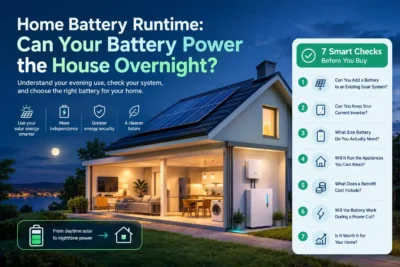
Thuisbatterij Looptijd: Kan Uw Batterij Het Huis De Nacht Door Van Stroom Voorzien?
De gebruiksduur van de thuisbatterij hangt af van hoeveel bruikbare energie je hebt en wat je ermee aandrijft. Een batterij kan de

Zonnebatterij Retrofit: 7 Slimme Checks Voor U Koopt
A solar battery retrofit means adding battery storage to solar panels you already have. In many cases, you can keep

Is een 5kWh Thuisbatterij Genoeg? 5 Essentiële Checks Voor Het Kopen
A 5kWh home battery can cover modest evening electricity use or keep selected essentials running during a power cut. Whether
 English
 Polish
 Romanian
 German
 Dutch
 French
 Bulgarian
 Croatian
 Greek
 Czech
 Danish
 Estonian
 Finnish
 Swedish
 Hungarian
 Irish
 Italian
 Latvian
 Lithuanian
 Luxembourgish
 Maltese
 Portuguese
 Slovak
 Slovenian
 Spanish