A home battery in the Netherlands may help you use more of your own solar electricity after net metering ends in 2027. But buying one simply because the rules are changing could be an expensive mistake. The value depends on your household’s energy use, export compensation, electricity contract and the total cost of the system.
What changes when Dutch net metering ends?
The Dutch government says the salderingsregeling will end on 1 January 2027. Until then, eligible households can offset electricity exported to the grid against electricity they later take from it. After the scheme ends, solar owners can still export power, but they will receive compensation under their supplier’s terms rather than offsetting it in the same way. Check your own contract: compensation and export-related charges can vary. Dutch government guidance
This change makes the timing of electricity use more important. Electricity used while solar panels are producing does not need to be bought from the grid. A battery can store some daytime surplus for use later, often in the evening. It cannot, however, store an entire summer’s surplus for winter—and some energy is lost when a battery charges and discharges.
What did a real Dutch household test find?
A 2026 study by CE Delft for the Dutch homeowners’ association Vereniging Eigen Huis examined data from home-battery pilot projects. In one representative setup, a 5 kWh battery increased the household’s self-consumption from 35% to 68%.
That result is useful, but it is not a promise of what another household will achieve. The same study found that outcomes varied between homes. Estimated payback periods in two tested setups ranged from 6.5 to 22 years. CE Delft concluded that batteries did not fully compensate for the end of net metering, and that future returns remain uncertain. CE Delft study summary
The practical point is that a home battery in the Netherlands is more likely to make sense when a household regularly exports solar power during the day and uses electricity later. A home that already uses most of its solar electricity as it is produced may have less surplus to store.
Check your own electricity use before choosing a size
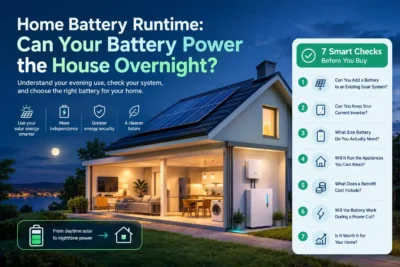
Don’t start by picking a battery capacity from a product title. First look at your electricity import and export data. Hourly or 15-minute readings, if available from your supplier or smart meter, can show when you send electricity to the grid and when you need it at home.
Ask yourself:
- How much solar electricity do I export on a typical day?
- How much electricity does my household use after sunset?
- Do an electric vehicle or heat pump add significant demand?
- What does my supplier pay for exported electricity?
- Does my contract offer lower prices at certain times?
Monthly bills show total consumption, but not always when it happens. That timing can make a big difference to whether storage will be useful. A properly sized battery should reflect the electricity you can realistically store and use—not just your annual consumption.
What to check before buying a LiFePO4 battery
Capacity is only one part of a LiFePO4 battery specification. Check the usable capacity, charging and discharging limits, and whether the battery is compatible with your exact inverter model. The battery, BMS and inverter need to communicate and operate within compatible voltage and current limits.
If you want backup power, ask whether the system can actually supply electricity during a grid outage. Not every battery installation provides whole-home backup; some require extra equipment and only support selected circuits.
Also check that the product’s voltage, amp-hour rating and advertised kWh agree. If the figures conflict, ask the seller for clarification before ordering. Clear and consistent specifications are essential when comparing home energy products.
Is a home battery worth buying before 2027?
There is no universal answer. A home battery in the Netherlands may be worth investigating if you export a regular solar surplus and use a meaningful amount of electricity in the evening. The case may be weaker if you already consume most of your solar generation directly, receive favourable export terms, or face a high installed cost.
Before deciding, compare your own meter data, supplier contract and full system cost. Ask a qualified installer to confirm inverter compatibility and local installation requirements. Treat savings or payback estimates as estimates, not guarantees.
You can browse Fench Energy’s LiFePO4 home battery range. If you already have an inverter, share its exact make and model with the team before choosing a battery so compatibility can be checked against the product specifications.
Common questions
Will a battery replace net metering?
No. It can store some surplus electricity for later use, but capacity is limited and charging and discharging involve energy losses. It cannot move summer electricity into winter.
Will a home battery definitely pay for itself after 2027?
No. Results depend on your energy use, export compensation, tariff, equipment and installation costs. Use your own meter data rather than a generic payback promise.
What size battery should I choose?
Start with your exported solar electricity and evening use. Then compare usable capacity, output power and inverter compatibility with a qualified installer.




 English
 Polish
 Romanian
 German
 Dutch
 French
 Bulgarian
 Croatian
 Greek
 Czech
 Danish
 Estonian
 Finnish
 Swedish
 Hungarian
 Irish
 Italian
 Latvian
 Lithuanian
 Luxembourgish
 Maltese
 Portuguese
 Slovak
 Slovenian
 Spanish