


Odabir kućne baterije nije samo pitanje kapaciteta i cijene. Ako već imate solarni inverter, baterija također mora odgovarati električnim i komunikacijskim zahtjevima invertera.
Ovo je posebno važno pri dodavanju LiFePO4 baterije postojećem solarnom PV sustavu. Dva proizvoda mogu biti opisana kao “48V” ili “51.2V”, na primjer, ali to ne znači nužno da mogu ispravno komunicirati ili raditi zajedno.
Prije naručivanja baterije, vrijedi provjeriti nekoliko specifikacija.
Zašto je kompatibilnost baterije sa solarnim inverterom važna?
Inverter i baterija imaju različite uloge, ali moraju razmjenjivati informacije tijekom normalnog rada. BMS baterije prati parametre poput napona ćelije, struje baterije i stanja napunjenosti (SOC), dok inverter kontrolira punjenje i praženje prema dostupnim informacijama o bateriji.
Ako ta dva uređaja nisu pravilno usklađena, sustav može imati komunikacijske pogreške, netočna SOC očitanja, ograničeno punjenje ili praženje ili neočekivana isključivanja.
Zbog toga se kompatibilnost treba provjeriti s obje električne i komunikacijske strane.
1. Provjerite raspon napona baterije
Napon je jedna od prvih specifikacija za usporedbu.
Mnogi sustavi za pohranu energije u kućanstvima koriste bateriju klase 48V. Tipična 51,2V LiFePO4 baterija, na primjer, koristi 16 ćelijapovezanih u seriju, s nominalnim naponom ćelije od 3,2V.
Međutim, nominalni napon je samo dio slike. Naveden raspon napona baterije invertera također bi trebao pokrivati stvarni radni napon baterije.
Pri usporedbi dvaju tehničkih listova provjerite:
- Nominalni napon baterije
- Radni raspon napona baterije
- Maksimalni napon punjenja
- Maksimalna struja punjenja
- Maksimalna struja praženja
- Ulazni raspon napona baterije invertera
Baterija ne bi trebala biti odabrana samo zato što su oba proizvoda označena kao “48V”. Proizvođačeve električne specifikacije pružaju mnogo pouzdaniju osnovu za kompatibilnost.
2. Provjerite CAN ili RS485 komunikaciju
Za mnoge moderne sustave za pohranu energije, komunikacija između BMS-a baterije i invertera jednako je važna kao i električna veza.
CAN communication is widely used in battery energy storage systems. It allows the BMS to send information such as SOC, voltage, current and charge/discharge limits to the inverter.
RS485 is another common communication interface. Depending on the equipment, it may be used for BMS communication or other system functions.
Having the same physical interface, however, does not automatically guarantee compatibility. The devices also need to use a compatible communication protocol and configuration.
Before purchasing, check:
- Which communication interface the inverter requires
- Which interface the battery BMS supports
- Whether the inverter recognises the battery’s BMS protocol
- Whether a specific communication cable or pinout is required
- Whether additional inverter or BMS settings are needed
If the manufacturer provides a battery compatibility list, this is usually the best place to start.
3. Check the Exact Inverter Model
Do not rely on the inverter brand alone.
Deye, Victron Energy, Growatt, SMA, GoodWe and MUST all offer different inverter models, and the supported battery types, communication methods and configuration options can vary between models.
For example, knowing that a system uses a Deye inverter is useful, but the exact model number is normally needed for a proper compatibility check.
Before buying a battery, record the:
- Inverter manufacturer
- Exact model number
- Battery voltage range
- Maximum charge and discharge current
- Supported communication interfaces
- Compatible battery or BMS protocols
The inverter’s user manual or official compatibility documentation should be treated as the primary reference.
4. Read the Battery Datasheet Carefully
A good battery datasheet should provide enough technical information for a basic compatibility assessment.
Pay particular attention to:
- Nominal voltage
- Rated capacity
- Operating voltage
- Maximum continuous charge current
- Maximum continuous discharge current
- Communication interface
- BMS information
- Operating temperature
- Supported inverter protocols or compatible inverter list
If the battery manufacturer only states that a battery is “compatible with solar inverters” without explaining the supported communication interfaces or protocols, it is worth asking for more detailed documentation.
For a home energy storage system, clear technical documentation is often a better indication of product quality than a long list of marketing features.
5. Confirm the Battery and Inverter Current Limits
Current ratings are sometimes overlooked when comparing batteries.
The inverter has a maximum charging and discharge current, while the battery and its BMS also have their own limits. The system should be configured within the limits specified by the manufacturers.
For example, a battery with a high capacity does not automatically mean that it can deliver unlimited power. The available output power depends on factors including battery voltage, current limits and BMS protection settings.
This is particularly relevant when selecting a larger home battery for a high-power inverter.
A Practical Compatibility Check Before Buying
Before placing an order, confirm these points with the inverter and battery documentation:
- Is the battery voltage within the inverter’s supported range?
- Are the battery’s charge and discharge current limits suitable?
- Does the inverter support the battery’s communication interface?
- Is the BMS communication protocol supported?
- Is the required communication cable or pinout specified?
- Is the exact inverter model included in the compatibility information?
If any of these points are unclear, it is better to confirm them with the battery or inverter manufacturer before installation.
Frequently Asked Questions
Can any 51.2V LiFePO4 battery work with a solar inverter?
No. A 51.2V nominal battery may be electrically suitable for a 48V-class system, but the inverter must also support the battery’s operating voltage, current limits and, where required, BMS communication protocol.
How do I check whether my inverter is compatible with a home battery?
Start with the inverter’s exact model number and compare its battery voltage range, current limits, communication interface and supported battery protocols with the battery manufacturer’s datasheet or compatibility list.
Final Thoughts
Checking kompatibilnost baterije solarnog invertera before buying can prevent many of the problems that only become apparent during installation.
For an existing solar PV system, start with the inverter model and technical documentation. Then compare the battery voltage range, charge and discharge limits, CAN or RS485 interface and BMS communication requirements.
If you are considering a Fench Energy LiFePO4 home battery, providing the exact inverter model before purchase is the most reliable way to determine whether the battery is suitable for your system. Where compatibility depends on a specific communication protocol or configuration, technical confirmation is preferable to relying on the battery’s nominal voltage alone.
Battery Backup for Refrigerator: What Size Do You Need?
A battery backup for refrigerator use must do two jobs: start the compressor and keep the fridge running through an
LiFePO4 vs olovna kiselina za solarnu energiju: vrijedi li nadogradnja?
Usporedba LiFePO4 i olovno-kiselih baterija za solar obično počinje s praktičnim problemom: vaše baterije više ne traju kroz
Možete li instalirati kućnu bateriju u negrijanom garaži?
Instalacija kućne baterije u garaži može imati smisla. Oprema ostaje izvan vašeg životnog prostora, i
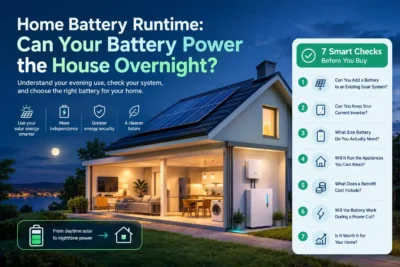
Radni vijek kućne baterije: može li vaša baterija napajati kuću preko noći?
Radni vijek kućne baterije ovisi o količini upotrebljive energije i što pokrećete. Baterija može održavati

Nadogradnja solarne baterije: 7 pametnih provjera prije kupnje
Nadogradnja solarne baterije znači dodavanje skladišta baterije postojećim solarnim panelima. U mnogim slučajevima možete zadržati

Je li kućna baterija od 5 kWh dovoljna? 5 ključnih provjera prije kupnje
Kućna baterija od 5 kWh može pokriti umjerenu večernju potrošnju električne energije ili održavati odabrane bitne uređaje tijekom nestanka struje. Bilo da
 English
 Polish
 Romanian
 German
 Dutch
 French
 Bulgarian
 Croatian
 Greek
 Czech
 Danish
 Estonian
 Finnish
 Swedish
 Hungarian
 Irish
 Italian
 Latvian
 Lithuanian
 Luxembourgish
 Maltese
 Portuguese
 Slovak
 Slovenian
 Spanish