



Home battery storage without solar lets you charge a battery from the grid and use that electricity later. It can lower electricity costs when cheaper charging periods are available, or provide backup power with the right equipment.
Whether it is worth buying depends on three things: your electricity tariff, how much power you use during expensive hours, and the total installed cost. A battery stores electricity; it does not generate free energy.
Here is how to decide whether a battery-only system suits your home.
How Does Home Battery Storage Without Solar Work?
A typical system includes a battery, a compatible inverter/charger, controls and electrical protection. The inverter/charger manages electricity flowing between the grid, battery and household circuits.
With a time-of-use tariff, you can:
- Charge during lower-priced periods.
- Use stored electricity when grid prices are higher.
- Keep some energy in reserve if the system supports backup.
Some systems use a fixed charging schedule. Others adjust charging through compatible energy management software. Automatic tariff control depends on the equipment, software integration and electricity provider.
This type of installation is already available. Octopus Energy explains how battery storage without solar panels can help households shift electricity purchases to cheaper periods.
Can a Home Battery Without Solar Save Money?
Yes, when the electricity it replaces costs enough more than the electricity used to charge it. The price difference must also cover charging and discharging losses.
A useful first estimate is:
Gross saving per kWh delivered = peak rate − (off-peak rate ÷ round-trip efficiency)
Use the overall system efficiency, including power conversion, rather than a battery-cell efficiency figure.
Example: Charging Overnight and Using Electricity in the Evening
The following figures are illustrative, not a Fench Energy performance claim or a quotation from an electricity supplier.
| Assumption | Example Value |
|---|---|
| Off-peak electricity price | €0.12/kWh |
| Peak electricity price | €0.30/kWh |
| Overall round-trip efficiency | 90% |
| Energy delivered to the home during peak hours | 8kWh |
To deliver 8kWh at 90% efficiency, the system needs approximately 8.89kWh of grid electricity.
| Calculation | Result |
|---|---|
| Battery charging cost: 8.89 × €0.12 | €1.07 |
| Buying 8kWh directly at the peak rate: 8 × €0.30 | €2.40 |
| Gross electricity saving for that day | €1.33 |
This saving excludes the purchase price, installation, battery ageing and any additional costs not included in the efficiency assumption. Savings will also change if you use less stored energy or electricity rates change.
How Do You Estimate the Payback Period?
Start with:
Simple payback period = total installed cost ÷ estimated annual net savings
Include the battery, inverter, installation and required electrical work in the installed cost. Estimate savings using your actual consumption and tariff, allowing for losses and ongoing costs.
Do not assume every day will match the example above. Ask for the assumptions behind any payback estimate, especially future electricity prices and battery performance.
When Is Battery Storage Without Solar Worth Considering?
Your Tariff Has a Useful Price Difference
Compare the full tariff, including peak rates, cheaper charging windows and standing charges. Check eligibility and whether grid charging is permitted.
A cheap overnight rate is less useful if the charging window is too short or the daytime rate makes your remaining grid consumption more expensive.
You Use Electricity During Peak Hours
Evening cooking, lighting and appliance use may create demand that a battery can cover.
Check hourly or half-hourly smart-meter data where available. A monthly bill shows total consumption, but not how much of it falls within expensive periods.
You Value Backup Power
Keeping essential appliances running can matter even when electricity savings are modest.
Decide which loads you need and for how long. Then confirm that the proposed system supports them during an outage.
When Might a Home Battery Be Poor Value?
Home battery storage without solar may deliver limited financial benefit when:
- Electricity costs the same throughout the day.
- You use little electricity during peak periods.
- The price difference is too small to cover losses and ownership costs.
- Installation requires substantial electrical upgrades.
- You can run appliances directly during cheaper hours.
With a flat electricity tariff, battery losses generally increase the energy purchased for the same household use. Backup may still justify the expense, but savings from shifting electricity use would not.
What Size Home Battery Do You Need Without Solar?
Size the battery around the consumption you want to cover, rather than your entire daily electricity use.
If you use 6kWh during expensive evening hours, compare options that can deliver that energy while allowing for conversion losses and any backup reserve. Check usable capacity, which can differ from the nominal capacity advertised.
Check Charging Speed and Output Power
Capacity alone does not determine whether a battery suits your home.
| Spezifikation | What It Tells You |
|---|---|
| Usable capacity, in kWh | How much stored energy is available |
| Charging power, in kW | How quickly the system can recharge |
| Continuous output, in kW | Which loads can run together |
| Surge capability | Whether the system can handle supported starting loads |
For example, storing 10kWh within a three-hour charging window requires more than 3.3kW of average input once charging losses are included.
Both the inverter and battery must support the required power.
Will a Battery Without Solar Work During a Power Cut?
Only if the system is designed and installed for backup. A battery used for electricity bill savings does not automatically keep the house powered during an outage.
Confirm the backup output, grid-isolation equipment, supported circuits and transfer time with your installer. Pumps and compressors may need extra starting power.
Without solar or another supported charging source, the available backup energy is limited to the battery’s stored charge until grid power returns.
Can You Add Solar Panels Later?
Often, yes, but plan for this before choosing the equipment.
A suitable hybrid inverter may support future solar panels. Other arrangements may require a separate solar inverter or additional equipment.
Ask the installer to confirm future solar connections, battery expansion limits and compatibility. For a LiFePO4 battery, the operating voltage, current limits and BMS communication must suit the selected inverter.
Choosing a Battery for Your Home
Before requesting a quotation, gather your electricity tariff, peak-period consumption, installation location and backup requirements. Include your inverter model if you already have one.
Fench Energy supplies LiFePO4 batteries for home energy storage. Our team can discuss battery specifications and compatibility requirements; your installer should confirm the complete system design and installation costs.
Explore Fench Energy’s home energy storage products and contact us with your requirements for a quotation.
Battery Backup for Refrigerator: What Size Do You Need?
A battery backup for refrigerator use must do two jobs: start the compressor and keep the fridge running through an
LiFePO4 vs Blei-Säure für Solar: Lohnt sich ein Upgrade?
Der Vergleich von LiFePO4- und Blei-Säure-Batterien für Solar beginnt meist mit einem praktischen Problem: Ihre Batterien halten nicht mehr durch
Kann man eine Heim-Batterie in einer unbeheizten Garage installieren?
Die Installation einer Heimbatterie in einer Garage kann sinnvoll sein. So bleibt die Ausrüstung aus Ihrem Wohnbereich heraus, und
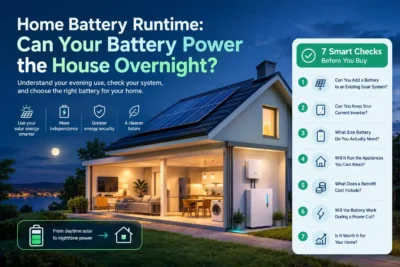
Laufzeit der Heimbatterie: Kann Ihre Batterie das Haus über Nacht mit Strom versorgen?
Die Laufzeit der Hausbatterie hängt davon ab, wie viel nutzbare Energie Sie haben und was Sie betreiben. Eine Batterie kann die

Solarbatterie-Nachrüstung: 7 clevere Prüfungen vor dem Kauf
Eine Solar-Batterie-Nachrüstung bedeutet, Batteriespeicher zu bereits vorhandenen Solarmodulen hinzuzufügen. In vielen Fällen können Sie

Reicht eine 5kWh-Heimbatterie aus? 5 wichtige Prüfungen vor dem Kauf
Eine 5kWh-Heimbatterie kann einen moderaten Stromverbrauch am Abend abdecken oder ausgewählte wichtige Geräte während eines Stromausfalls am Laufen halten. Ob
 English
 Polish
 Romanian
 German
 Dutch
 French
 Bulgarian
 Croatian
 Greek
 Czech
 Danish
 Estonian
 Finnish
 Swedish
 Hungarian
 Irish
 Italian
 Latvian
 Lithuanian
 Luxembourgish
 Maltese
 Portuguese
 Slovak
 Slovenian
 Spanish