


Kazalo vsebine
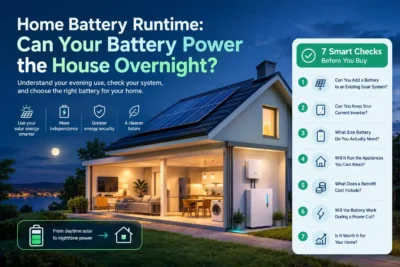
Čas delovanja domače baterije: ali lahko vaša baterija napaja hišo čez noč?
Čas delovanja domače baterije je odvisen od količine uporabne energije, ki jo imate, in od tega, kaj uporabljate. Baterija lahko ohranja hladilnik, luči in Wi-Fi delujoče do jutra. Dodajte električno ogrevanje ali ure klimatske naprave in izračun se hitro spremeni.
Torej, ali lahko domača baterija napaja vaš dom čez noč? Da, z dovolj shranjene energije in ustreznim sistemom. Toda “čez noč” lahko pomeni osem mirnih ur v enem domu in dvanajst zaposlenih ur v drugem.
Tukaj je pet preverjanj, ki vam bodo pomagala pri izbiri.
1. Začnite z vašo večerno porabo elektrike
Pred primerjavo baterij preverite svoj pametni števec ali aplikacijo za spremljanje. Oglejte si porabo med sončnim zahodom in naslednjim jutrom v več predstavitvenih dneh.
Mesečni seštevki ne pokažejo, kdaj uporabljate elektriko. Vključite vikende in hladnejša ali toplejša obdobja, ko se lahko ogrevanje in hlajenje spremenita.
Če nimate podrobnih meritev, navedite naprave, za katere pričakujete, da jih boste uporabljali. Ta primer zajema nekaj osnovnih:
| Naprava | Prikazana poraba | Čas delovanja | Energija |
|---|---|---|---|
| Hladilnik | Povprečno 50W | 10 ur | 0,50 kWh |
| Wi-Fi usmerjevalnik | 10W | 10 ur | 0,10 kWh |
| Štiri LED luči | Skupaj 32W | 5 ur | 0,16 kWh |
| Televizija | 80W | 3 ure | 0,24 kWh |
| Skupaj | 1,00 kWh |
To so predpostavke za izračun, ne povprečja izmerjena v gospodinjstvu. Kuhanje, ogrevanje, hlajenje, topla voda in druge naprave niso vključene.
For a refrigerator, use measured energy consumption or an estimate from its energy label. Its compressor switches on and off, so multiplying its running wattage by the whole night can overstate consumption. The US Department of Energy’s appliance guide explains how energy labels help compare appliance use.
2. Calculate Home Battery Runtime From Available Energy
The basic calculation is:
Runtime in hours = energy available to appliances in kWh ÷ average load in kW.
The important part is “available to appliances.”
Nominal capacity is the battery’s rated energy. Manufacturer operating limits, your starting charge, backup reserve and inverter losses affect how much you can use.
For illustration, assume 80% of nominal energy is available for the overnight period and conversion efficiency is 90%:
| Nominal battery size | Calculated energy reaching loads | Runtime at 500W average |
|---|---|---|
| 5.12kWh | 3.69kWh | About 7.4 hours |
| 16kWh | 11.52kWh | About 23 hours |
These are mathematical examples, not Fench Energy test results. They assume no recharging and do not separately account for inverter standby consumption. Temperature, ageing and changing loads also affect results.
If a specification already provides usable energy, don’t deduct the same operating allowance again.
Naš home battery sizing guide explains how to turn your appliance list into a capacity estimate.
3. Check the Appliances That Change the Answer
The refrigerator usually isn’t the whole story.
An appliance averaging 1kW for eight hours uses 8kWh. That single load could outweigh all the essentials in the first table several times over.
Air conditioners and heat pumps vary with weather, settings and building conditions. Measure their consumption where possible instead of assuming they draw their rated input continuously.
Power matters too. kWh describes stored energy; kW describes how much power the system can supply at once.
A larger battery does not automatically mean you can run the oven, kettle and air conditioner together. Check the inverter’s continuous output, appliance starting requirements and battery discharge limits.
A full battery is little comfort if the system cannot support the appliances you switch on.
4. Decide Whether 5kWh or 16kWh Fits Your Routine
A 5kWh-class battery may suit modest evening demand or selected essential loads. A 16kWh-class battery is worth evaluating when you need more overnight energy or a longer backup period.
Fench Energy offers a 5.12kWh wall-mounted battery and a 16kWh range shown in its home storage selection. Compare the exact model’s usable capacity, output limits, installation requirements and documentation.
Also consider how you will refill it. A large battery helps less if your solar system rarely produces enough surplus to charge it. Grid charging may be another option where equipment settings and electricity tariffs support it.
If you’re considering the smaller option, our 5kWh home battery guide covers the main buying checks.
5. Confirm What Happens During a Power Cut
Using stored energy at night and supplying backup during an outage are different capabilities.
Some installations reduce evening grid purchases but do not keep appliances running when the grid fails. Backup may require suitable switching equipment, a dedicated inverter output and selected household circuits.
Ask your installer which appliances will remain powered and whether solar can recharge the battery during an outage. Energy Saving Trust’s battery storage guide provides useful background on storage and backup considerations.
Before ordering, contact Fench Energy with your inverter model, country and overnight electricity use—or a list of essential appliances. Request suitable product specifications and compatibility confirmation, then have a qualified local installer check the complete system.
Related Articles
Battery Backup for Refrigerator: What Size Do You Need?
A battery backup for refrigerator use must do two jobs: start the compressor and keep the fridge running through an
LiFePO4 proti svinčevi bateriji za sončno energijo: ali se nadgradnja splača?
Comparing LiFePO4 vs lead acid for solar usually starts with a practical problem: your batteries no longer last through the
Ali lahko namestite domačo baterijo v neogrevani garaži?
Installing a home battery in a garage can make sense. It keeps the equipment out of your living space, and
Čas delovanja domače baterije: ali lahko vaša baterija napaja hišo čez noč?
Čas delovanja domače baterije je odvisen od količine uporabne energije, ki jo imate, in od tega, kaj poganjate. Baterija lahko ohrani

Nadgradnja sončne baterije: 7 pametnih preverjanj pred nakupom
A solar battery retrofit means adding battery storage to solar panels you already have. In many cases, you can keep

Ali je domača baterija 5 kWh dovolj? 5 ključnih preverjanj pred nakupom
A 5kWh home battery can cover modest evening electricity use or keep selected essentials running during a power cut. Whether
 English
 Polish
 Romanian
 German
 Dutch
 French
 Bulgarian
 Croatian
 Greek
 Czech
 Danish
 Estonian
 Finnish
 Swedish
 Hungarian
 Irish
 Italian
 Latvian
 Lithuanian
 Luxembourgish
 Maltese
 Portuguese
 Slovak
 Slovenian
 Spanish