


El La vida útil de la batería LiFePO4 es una de las principales razones por las que los propietarios eligen baterías de fosfato de hierro y litio para almacenamiento solar, energía de respaldo, vehículos recreativos y sistemas fuera de la red. Una batería LiFePO4 de calidad puede proporcionar a menudo 8–15 años de servicio, con muchas baterías calificadas para miles de ciclos de carga.
Sin embargo, la vida útil por ciclos por sí sola no determina cuánto tiempo durará realmente una batería. La profundidad de descarga (DoD), la temperatura, las condiciones de carga, la corriente de descarga, la protección del BMS y la calidad de las celdas afectan el envejecimiento de la batería.
Comprender estos factores puede ayudarle a obtener más valor de su batería y elegir la batería LiFePO4 adecuada para su aplicación.
¿Qué determina la vida útil de una batería LiFePO4?
La vida útil de una batería generalmente se describe por vida por ciclos y vida calendario.
La vida por ciclos se refiere al número de ciclos de carga y descarga que una batería puede completar antes de que su capacidad utilizable caiga a un nivel especificado, comúnmente alrededor del 80% de su capacidad original.
Por ejemplo, una batería calificada para 4,000 ciclos al 80% DoD se espera que alcance ese conteo de ciclos bajo las condiciones de prueba indicadas por el fabricante.
La vida calendario es la cantidad de tiempo que una batería puede permanecer en servicio independientemente de la frecuencia con que se cicla. Incluso una batería poco usada envejece gradualmente debido a la temperatura, condiciones de almacenamiento y el tiempo.
Por eso, una afirmación de “6,000 ciclos” siempre debe considerarse junto con las condiciones de prueba.
¿Cuántos ciclos dura una batería LiFePO4?
Las baterías LiFePO4 típicas pueden estar calificadas para:
- más de 2,000 ciclos
- 3,000–4,000 ciclos
- más de 5,000–6,000 ciclos
- 8,000+ cycles for some higher-end products
A simple way to estimate theoretical cycling time is:
Cycle life ÷ cycles per day = approximate years of cycling
For example:
4,000 cycles ÷ 365 days ≈ 11 years
This does not mean every 4,000-cycle battery will last exactly 11 years. The actual La vida útil de la batería LiFePO4 depends on how deeply it is discharged, operating temperature, charge and discharge rates, and the quality of the battery system.
How Does DoD Affect LiFePO4 Battery Lifespan?
Depth of Discharge (DoD) describes how much of the battery’s capacity is used during a cycle.
For example:
- 100% DoD = the full capacity is used
- 50% DoD = half of the capacity is used
- 20% DoD = one-fifth of the capacity is used
Frequent deep discharge can increase battery stress. If your home regularly uses most of the battery capacity, choosing a larger battery can reduce the average DoD and potentially improve the La vida útil de la batería LiFePO4.
For solar storage, it is often better to size the battery according to your actual daily energy consumption rather than selecting the smallest battery that can meet your basic load.
Does Temperature Affect LiFePO4 Battery Lifespan?
Yes. Temperature is an important factor in battery aging.
High temperatures can accelerate chemical degradation. For this reason, avoid installing a LiFePO4 battery in direct sunlight, next to a heat source, or in an enclosed area with excessive heat.
Cold temperatures require attention as well. LiFePO4 batteries generally perform less efficiently in very cold conditions, and charging below 0°C / 32°F can damage the cells unless the battery has suitable low-temperature charging protection or an integrated heating function.
For the best La vida útil de la batería LiFePO4, install the battery in a dry, stable location and follow the manufacturer’s recommended operating temperature range.
Does Charging Affect Battery Life?
Correct charging is essential for maintaining a long La vida útil de la batería LiFePO4.
Always use a charger or inverter that is compatible with LiFePO4 chemistry and follow the manufacturer’s recommended voltage and current settings.
Avoid:
- Overcharging
- Using incorrect charging profiles
- Charging below freezing without protection
- Exceeding the recommended charging current
If you are using a LiFePO4 battery with a solar system, check battery and inverter compatibility before installation.
Why Does the BMS Matter?
El Battery Management System (BMS) helps protect the battery during normal operation.
A properly designed BMS can provide protection against:
- Overcharge
- Over-discharge
- Overcurrent
- Short circuit
- Excessive temperature
Many BMS systems also monitor individual cell voltages and provide cell balancing. This helps keep the cells operating within an appropriate range.
A good BMS does not eliminate battery aging, but it can help prevent operating conditions that may shorten the La vida útil de la batería LiFePO4.
How to Extend LiFePO4 Battery Lifespan
You do not need complicated maintenance to get good performance from a LiFePO4 battery.
Follow these basic practices:
- Avoid unnecessary deep discharge.
- Use the correct LiFePO4 charging settings.
- Keep the battery away from excessive heat.
- Do not charge below freezing without suitable protection.
- Match battery capacity to your energy needs.
- Stay within the recommended charge and discharge current.
- Keep the battery dry and protected from direct sunlight.
- Check the BMS for warnings or abnormal temperatures.
- Follow the manufacturer’s storage recommendations.
Proper battery sizing is especially important for home solar systems. A battery that is consistently overloaded or deeply discharged may not deliver the same service life as a properly sized system.
What to Check Before Buying a LiFePO4 Battery
If you want a battery with a long La vida útil de la batería LiFePO4, do not compare products by cycle count alone.
Check:
- Rated cycle life and test conditions
- Recommended DoD
- Usable capacity
- Continuous discharge current
- Operating temperature
- Low-temperature charging protection
- BMS specifications
- Garantía
- Safety certifications
For example, a battery advertised as “6,000+ cycles” should be evaluated based on the DoD, temperature, charge rate, discharge rate, and end-of-life criteria used during testing.
Final Thoughts
El La vida útil de la batería LiFePO4 can often reach 8–15 years when the battery is properly sized, installed, and operated. Thousands of cycles are possible, but actual battery life depends on more than the number printed on a product page.
For home solar, backup power, and off-grid applications, pay particular attention to DoD, temperature, charging conditions, BMS protection, and battery capacity.
A longer-lasting battery is not simply the one with the highest cycle rating. It is the one that matches your system and is operated within its recommended limits.
Battery Backup for Refrigerator: What Size Do You Need?
A battery backup for refrigerator use must do two jobs: start the compressor and keep the fridge running through an
LiFePO4 vs Ácido de Plomo para Solar: ¿Vale la Pena Actualizar?
Comparing LiFePO4 vs lead acid for solar usually starts with a practical problem: your batteries no longer last through the
¿Se Puede Instalar una Batería Doméstica en un Garaje Sin Calefacción?
Installing a home battery in a garage can make sense. It keeps the equipment out of your living space, and
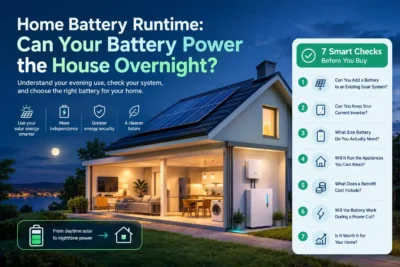
Duración de la batería doméstica: ¿Puede su batería alimentar la casa durante la noche?
Home battery runtime depends on how much usable energy you have and what you run. A battery may keep the

Adaptación de Batería Solar: 7 Controles Inteligentes Antes de Comprar
A solar battery retrofit means adding battery storage to solar panels you already have. In many cases, you can keep

¿Es Suficiente una Batería Doméstica de 5kWh? 5 Controles Esenciales Antes de Comprar
A 5kWh home battery can cover modest evening electricity use or keep selected essentials running during a power cut. Whether
 English
 Polish
 Romanian
 German
 Dutch
 French
 Bulgarian
 Croatian
 Greek
 Czech
 Danish
 Estonian
 Finnish
 Swedish
 Hungarian
 Irish
 Italian
 Latvian
 Lithuanian
 Luxembourgish
 Maltese
 Portuguese
 Slovak
 Slovenian
 Spanish