


Home battery dynamic electricity tariffs can help homeowners reduce electricity bills by storing energy when prices are low and using it when prices rise. In 2026, combining a home battery with a suitable electricity tariff may also help households make better use of solar energy and reduce reliance on expensive grid electricity.
However, a home battery does not automatically guarantee lower energy bills. Your potential savings depend on electricity price differences, battery efficiency, household consumption, installation costs, and how effectively your system manages charging and discharging.
In this guide, we explain how home battery dynamic electricity tariffs work, how to calculate potential savings, and what to consider before investing in residential energy storage.
What Are Home Battery Dynamic Electricity Tariffs?
Home battery dynamic electricity tariffs refer to using a home battery with an electricity contract whose energy prices change over time. Depending on the supplier and contract, electricity prices may change hourly or at shorter intervals.
Unlike a fixed-rate electricity tariff, a dynamic tariff allows consumers to benefit from periods when electricity prices are lower. However, prices can also rise, creating potential risks for households that cannot adjust their electricity consumption.
For example, electricity prices may fall when renewable energy generation is high and demand is low. Prices may increase during periods of high demand or limited supply.
According to the European Commission’s electricity market guidance, European electricity market reforms aim to give consumers more choice and protection when selecting electricity contracts.
Before choosing a dynamic tariff, check whether your supplier offers one in your area, whether a smart meter is required, and how network charges, taxes, and other fees affect your final electricity bill.
How Do Home Battery Dynamic Electricity Tariffs Work?
A home battery stores electricity so that you can use it later. When combined with a compatible inverter and energy management system, it can help you shift electricity consumption away from expensive periods.
1. Charge Your Home Battery When Electricity Prices Are Low
With a suitable dynamic tariff, you may be able to charge your home battery during periods of lower electricity prices and use the stored energy when prices rise.
For example, a household might charge its battery overnight when electricity is cheaper and use the stored electricity during an expensive evening period.
The potential benefit depends on the price difference between charging and discharging periods, battery efficiency, and any additional charges.
2. Store Excess Solar Energy for Later Use
If your home has rooftop solar panels, a battery can store surplus solar electricity generated during the day for use in the evening or early morning.
Without a battery, you may export surplus electricity to the grid and purchase electricity later. Whether storing that energy is more economical depends on the value of exported electricity compared with the cost of buying electricity from the grid.
Choosing the right capacity is important. Read our guide on how much home battery storage you need to understand how household consumption and usable battery capacity affect your system size.
3. Use Stored Electricity During Expensive Periods
When electricity prices increase, your battery can supply part of your household’s electricity demand, reducing the amount of electricity you need to purchase from the grid.
Some systems support automatic charging and discharging based on electricity prices. However, not every battery independently monitors dynamic tariffs or optimizes energy use automatically.
Before buying, confirm that your battery, inverter, and energy management software support your intended charging strategy.
You can also explore Fench Energy’s 51.2V 16kWh LiFePO4 solar battery as one option for residential energy storage. Check inverter compatibility, usable capacity, and control functionality before purchasing.
How Much Can Home Battery Dynamic Electricity Tariffs Save?
The potential savings depend on how much electricity you can shift from expensive periods to cheaper ones.
Consider this simplified example of charging a home battery from the grid.
| Αντικείμενο | Example assumption |
|---|---|
| Electricity purchased for charging | 10 kWh |
| Low-price electricity rate | €0.12/kWh |
| High-price electricity rate | €0.30/kWh |
| Round-trip battery efficiency | 90% |
| Electricity delivered after losses | 9 kWh |
Step 1: Calculate the charging cost.
10 kWh × €0.12/kWh = €1.20
Step 2: Calculate the cost of buying the same delivered electricity at the higher rate.
9 kWh × €0.30/kWh = €2.70
Step 3: Calculate the gross benefit.
€2.70 − €1.20 = €1.50 per cycle
Under these assumptions, the gross benefit is €1.50 per cycle compared with buying the same 9 kWh directly at the higher electricity price.
However, this is not net profit. The calculation excludes battery degradation, installation costs, fixed charges, additional fees, and potential income from exporting solar electricity.
What Electricity Price Difference Makes Battery Charging Worthwhile?
Battery efficiency affects the minimum price difference needed to make grid charging economical.
Using the example above, the charging cost per delivered kilowatt-hour is:
€0.12 ÷ 90% ≈ €0.133/kWh
The higher electricity price must therefore exceed approximately €0.133/kWh to create a positive gross benefit under these assumptions.
In practice, the break-even price must be higher if additional variable charges and battery degradation costs apply.
For a more accurate estimate, compare your actual electricity import prices, export compensation, battery efficiency, and expected usage.
Το ACER 2026 Monitoring Report on European retail energy markets discusses opportunities for consumers to benefit from dynamic pricing and shifting electricity consumption to lower-price periods.
Remember that savings from changing electricity consumption are not the same as savings generated by installing a home battery. Your actual results depend on your tariff, location, and energy usage.
Is a 5 kWh, 10 kWh, or 15 kWh Home Battery Better?
Choosing the right battery capacity is essential when evaluating home battery dynamic electricity tariffs. A larger battery does not automatically deliver greater savings because you may not use its additional capacity every day.
| Battery capacity | Potential use case |
|---|---|
| 5 kWh | Lower evening consumption or a smaller amount of surplus solar energy |
| 10 kWh | Moderate household consumption and regular solar storage |
| 15 kWh or more | Higher electricity demand, larger solar systems, or longer backup requirements |
These are general examples, not fixed recommendations. Your ideal battery size depends on daily electricity consumption, solar generation, usable capacity, charge and discharge power, and the amount of electricity you can economically shift between price periods.
Review your electricity bills and, if available, hourly or half-hourly consumption data before deciding.
What Should You Check Before Buying a Home Battery?
Before investing in a home battery for dynamic electricity tariffs, consider five important factors.
1. Usable battery capacity
Rated capacity is not always the same as the energy available to your appliances. Check usable capacity and the manufacturer’s operating limits.
2. Round-trip efficiency
Energy is lost during charging and discharging. Higher efficiency can improve the economics of storing electricity.
3. Inverter compatibility
Confirm that the battery works with your existing or planned inverter and supports the charging and discharging power your household requires.
4. Smart energy management
If you want automatic charging when electricity prices are low, check whether the system supports dynamic tariff integration, scheduled charging, or compatible third-party energy management software.
5. Battery lifespan, warranty, and safety
Review the warranty, operating temperature range, battery management system protection, applicable certifications, and battery aging characteristics.
Our guide to LiFePO4 battery lifespan explains how temperature, depth of discharge, and operating conditions can influence long-term battery performance.
Are Home Battery Dynamic Electricity Tariffs Worth It in 2026?
Home battery dynamic electricity tariffs may be attractive if you have rooftop solar panels, significant differences between low and high electricity prices, or household consumption that can be shifted to cheaper periods.
They may be less attractive if electricity prices remain similar throughout the day, your household uses little electricity, or the installed battery cost is too high relative to the potential savings.
Before purchasing, estimate your annual savings using your actual tariff and consumption data. Compare those savings with the total installed cost, expected battery lifespan, and potential maintenance or replacement expenses.
A battery may also provide backup power, but only if the system is designed and installed to support operation during a grid outage. Backup functionality depends on the inverter, electrical configuration, and installation requirements.
Frequently Asked Questions About Home Battery Dynamic Electricity Tariffs
Can I charge a home battery when electricity prices are low?
Yes, provided your battery, inverter, electricity connection, and energy management system support grid charging. Check your electricity supplier’s contract terms and any applicable network restrictions.
Can a home battery save money without solar panels?
Potentially. A battery can charge from the grid during cheaper periods and supply electricity when prices are higher. Whether this is economical depends on price differences, efficiency losses, fees, battery degradation, and system cost.
Do I need a smart meter for dynamic electricity tariffs?
Many dynamic tariffs require a smart meter or suitable interval-metering capability. Requirements vary by country and electricity supplier.
How long does a home battery take to pay for itself?
There is no universal payback period. It depends on total installed cost, annual savings, electricity prices, battery degradation, and any applicable incentives or export payments.
Can every home battery automatically follow dynamic electricity prices?
No. Automatic price-based charging depends on the capabilities of the inverter, battery management system, and energy management software. Confirm compatibility before buying.
Final Thoughts
Home battery dynamic electricity tariffs can create opportunities for homeowners to reduce energy costs, particularly when combined with solar panels and a compatible home battery.
The key is to choose a system that matches your household’s energy demand and supports your intended charging strategy. A larger battery is not necessarily more economical, and a lower electricity price does not automatically guarantee savings.
Compare your electricity tariff, review your energy consumption, and calculate the potential benefits before investing. With the right configuration, home energy storage can help you use electricity more strategically and make better use of your solar generation.
About the Author
Fench Energy Editorial Team
Fench Energy provides LiFePO4 battery solutions for residential solar storage and backup power applications. This guide helps homeowners understand dynamic electricity tariffs, battery economics, and important system selection considerations.
Editorial note: Electricity prices, tariff conditions, and battery performance vary by country and installation. The calculations in this article are illustrative examples, not financial guarantees or personalized energy advice.
Battery Backup for Refrigerator: What Size Do You Need?
A battery backup for refrigerator use must do two jobs: start the compressor and keep the fridge running through an
LiFePO4 vs Μολύβδου για Ηλιακή Ενέργεια: Αξίζει η Αναβάθμιση;
Comparing LiFePO4 vs lead acid for solar usually starts with a practical problem: your batteries no longer last through the
Μπορείτε να Εγκαταστήσετε Μπαταρία Σπιτιού σε Μη Θερμαινόμενο Γκαράζ;
Installing a home battery in a garage can make sense. It keeps the equipment out of your living space, and
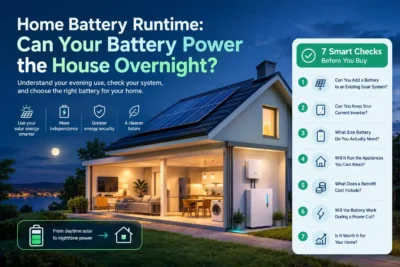
Χρόνος λειτουργίας οικιακής μπαταρίας: Μπορεί η μπαταρία σας να τροφοδοτήσει το σπίτι όλη τη νύχτα;
Home battery runtime depends on how much usable energy you have and what you run. A battery may keep the

Αναβάθμιση Ηλιακής Μπαταρίας: 7 Έξυπνοι Έλεγχοι Πριν Αγοράσετε
A solar battery retrofit means adding battery storage to solar panels you already have. In many cases, you can keep

Είναι μια οικιακή μπαταρία 5kWh αρκετή; 5 βασικοί έλεγχοι πριν την αγορά
A 5kWh home battery can cover modest evening electricity use or keep selected essentials running during a power cut. Whether
 English
 Polish
 Romanian
 German
 Dutch
 French
 Bulgarian
 Croatian
 Greek
 Czech
 Danish
 Estonian
 Finnish
 Swedish
 Hungarian
 Irish
 Italian
 Latvian
 Lithuanian
 Luxembourgish
 Maltese
 Portuguese
 Slovak
 Slovenian
 Spanish