


If you are wondering how many Ah you need for a LiFePO4 battery, start with your power consumption and required runtime. A 100Ah battery may be enough for a small RV or backup system, while larger loads may require 200Ah or 300Ah.
The right LiFePO4 battery size also depends on voltage. Ah alone does not tell you how much energy a battery stores.
How Many Ah Do I Need for a LiFePO4 Battery?
The simplest way to calculate battery capacity is to start with your energy consumption.
Power (W) × Runtime (hours) = Energy (Wh)
For example, if your appliances use a total of 1,500Wh per day and you use a 12.8V LiFePO4 battery:
1,500Wh ÷ 12.8V ≈ 117Ah
In practice, you should choose a larger battery because usable capacity is affected by depth of discharge (DoD), inverter losses, temperature, and battery operating conditions.
For this example, a 12V 200Ah LiFePO4 battery would provide a more practical capacity margin than a 100Ah battery.
What Does Ah Mean?
Ah means amp-hours and describes the electrical capacity of a battery.
However, Ah should always be considered together with voltage.
The basic calculation is:
Wh = Voltage × Ah
For example:
| LiFePO4 Battery | Nominal Energy |
|---|---|
| 12.8V 100Ah | 1.28kWh |
| 12.8V 200Ah | 2.56kWh |
| 12.8V 330Ah | 4.22kWh |
| 51.2V 314Ah | 16.07kWh |
This is why a 100Ah battery is not always equivalent to another 100Ah battery. A 12.8V 100Ah battery stores about 1.28kWh, while a 51.2V 100Ah battery stores about 5.12kWh.
When comparing a LiFePO4 battery, always check both Ah and voltage.
100Ah vs. 200Ah vs. 300Ah LiFePO4 Battery
100Ah LiFePO4 Battery
A 100Ah LiFePO4 battery is suitable for many small applications, including:
- RVs and campers
- Camping power
- Small solar systems
- Lights and electronics
- Basic backup power
A 12.8V 100Ah battery provides about 1.28kWh of nominal energy.
If your loads are small and your runtime requirements are limited, 100Ah can be a practical choice.
200Ah LiFePO4 Battery
A 200Ah LiFePO4 battery provides roughly twice the energy of a 100Ah battery at the same voltage.
A 12.8V 200Ah battery provides approximately:
12.8V × 200Ah = 2.56kWh
Choose 200Ah when you need longer runtime, more appliances, or more stored energy for an RV, off-grid system, or small solar setup.
300Ah+ LiFePO4 Battery
For higher energy requirements, a 300Ah-class battery provides more capacity without immediately adding multiple batteries.
For example:
12.8V × 330Ah ≈ 4.22kWh
A 330Ah LiFePO4 battery can be useful for larger RVs, off-grid applications, and systems with higher daily energy use.
How Long Will a 100Ah LiFePO4 Battery Last?
There is no single answer because runtime depends on the load.
A 12.8V 100Ah battery has approximately 1.28kWh of nominal energy.
With a 100W load:
1.28kWh ÷ 0.1kW ≈ 12.8 hours
This is a theoretical estimate. Actual runtime will be lower depending on usable capacity, inverter efficiency, temperature, and the battery’s operating conditions.
If your load increases to 500W, the same 100Ah battery will run for much less time.
Should You Choose 12V, 24V, or 48V?
The right voltage depends on your system and inverter.
12V LiFePO4 batteries are common for RVs, camping, boats, and small backup systems.
24V batteries can be a better fit for medium-sized systems with higher power requirements.
For larger solar and home energy storage systems, 48V-class LiFePO4 batteries, including 51.2V systems, are generally more practical.
For example, a 51.2V 314Ah battery provides:
51.2V × 314Ah ≈ 16.07kWh
At this size, it is more useful to think in terms of kWh rather than Ah because the battery is designed for a much larger energy storage system.
What Else Should You Check?
Ah is only one part of choosing a LiFePO4 battery. Before buying, check:
- Nominal voltage
- Usable capacity and DoD
- Continuous discharge current
- BMS protection
- Inverter compatibility
- Cycle life
- Operating temperature
- Warranty and certifications
A battery can have enough Ah but still be unsuitable for a high-power inverter if its BMS or continuous discharge current is too low.
Always check the manufacturer’s datasheet for the battery’s actual operating limits and installation requirements.
Which LiFePO4 Battery Size Is Right for You?
As a general starting point:
| Application | Typical Starting Capacity |
|---|---|
| Small backup and electronics | 50–100Ah |
| RV and camping | 100–200Ah |
| Larger RV or off-grid use | 200–330Ah |
| Home solar storage | 48V/51.2V system |
| Larger energy storage | 10kWh+ |
These are general guidelines, not fixed requirements.
To determine how many Ah you need for a LiFePO4 battery, calculate your energy use first, then consider voltage, usable capacity, and required runtime.
Final Thoughts
The right LiFePO4 battery size depends on your actual energy needs, not simply the highest Ah rating.
For smaller systems, 100Ah may be enough. If you need more runtime, 200Ah can provide a useful increase in capacity, while 300Ah or more is better suited to larger loads.
Remember:
Once you understand this relationship, it becomes much easier to compare 100Ah, 200Ah, and 300Ah LiFePO4 batteries and choose the capacity that fits your system.

Battery Backup for Refrigerator: What Size Do You Need?
A battery backup for refrigerator use must do two jobs: start the compressor and keep the fridge running through an
LiFePO4 vs Lead Acid for Solar: Is Upgrading Worth It?
Comparing LiFePO4 vs lead acid for solar usually starts with a practical problem: your batteries no longer last through the
Can You Install a Home Battery in an Unheated Garage?
Installing a home battery in a garage can make sense. It keeps the equipment out of your living space, and
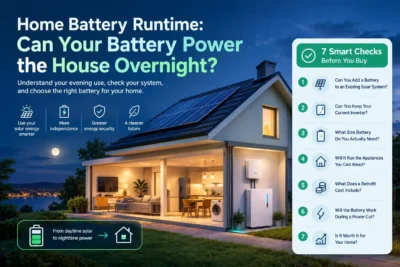
Home Battery Runtime: Can Your Battery Power the House Overnight?
Home battery runtime depends on how much usable energy you have and what you run. A battery may keep the

Solar Battery Retrofit: 7 Smart Checks Before You Buy
A solar battery retrofit means adding battery storage to solar panels you already have. In many cases, you can keep

Is a 5kWh Home Battery Enough? 5 Essential Checks Before Buying
A 5kWh home battery can cover modest evening electricity use or keep selected essentials running during a power cut. Whether
 English
 Polish
 Romanian
 German
 Dutch
Dutch French
 Bulgarian
 Croatian
 Greek
Greek Czech
Czech Danish
 Estonian
 Finnish
 Swedish
 Hungarian
 Irish
Irish Italian
 Latvian
 Lithuanian
 Luxembourgish
 Maltese
 Portuguese
 Slovak
 Slovenian
 Spanish