


If you are wondering how much home battery storage do I need, the answer depends on three things: how much electricity you use, which appliances you want to back up, and how long you want the battery to run.
For many homes, a 5–10kWh battery can cover essential loads during a short outage. If you want longer backup or want to store more solar energy for use at night, a 10–16kWh LiFePO4 home battery may be a better fit.
The key is to size the battery around your actual energy needs rather than simply choosing the largest battery you can afford.
How Much Home Battery Storage Do I Need?
A quick estimate looks like this:
| Home Use | Typical Battery Size |
|---|---|
| Lights, Wi-Fi, phones and small devices | 1–3kWh |
| Refrigerator, lights, Wi-Fi and TV | 3–5kWh |
| Essential home backup for several hours | 5–10kWh |
| Larger backup or daily solar storage | 10–16kWh+ |
These are starting points, not fixed requirements. Your actual battery storage capacity depends on the power consumption of your appliances and how long you need them to operate.
How to Calculate Your Home Battery Size
The easiest way to estimate your needs is to calculate how much energy your essential appliances use.
Power (W) × Running Time (hours) = Energy (Wh)
For example:
- Refrigerator: 100W × 8 hours = 800Wh
- Lights: 60W × 5 hours = 300Wh
- Wi-Fi router: 12W × 24 hours = 288Wh
- Laptop: 60W × 3 hours = 180Wh
Total:
1,568Wh ≈ 1.6kWh
This means you need about 1.6kWh of usable energy for these loads under these assumptions.
However, you should not choose a 1.6kWh battery simply because the calculation equals 1.6kWh. Inverter losses, battery discharge settings, temperature, and unexpected loads all reduce the energy available to your appliances.
A practical sizing formula is:
Required Battery Capacity = Energy Needed ÷ Usable DoD ÷ Inverter Efficiency
For example, if your essential loads require 8kWh and you assume 90% usable battery capacity and 90% inverter efficiency:
8 ÷ 0.90 ÷ 0.90 ≈ 9.9kWh
In this situation, a 10kWh-class home battery would be a reasonable starting point.
Usable Capacity vs. Battery Capacity
One of the most common mistakes when buying a home battery is looking only at the number of kWh on the product label.
A battery’s nominal capacity is the total rated energy. Its usable capacity is the energy you can realistically use under the battery manufacturer’s operating limits.
For example, a 10kWh battery does not necessarily mean you will deliver exactly 10kWh to your appliances.
Your actual runtime also depends on:
- Inverter efficiency
- Depth of discharge (DoD)
- Appliance power consumption
- Temperatura della batteria
- Battery and inverter operating settings
For this reason, compare batteries based on di energia utilizzabile, not just nominal kWh.
How Long Will a Home Battery Last?
Battery runtime depends mainly on the load you connect to it.
A simple calculation is:
Runtime (hours) ≈ Usable Battery Energy (kWh) ÷ Load (kW)
For example, a 10kWh battery with 9kWh of usable energy powering a continuous 500W load could theoretically provide:
9kWh ÷ 0.5kW = 18 hours
Actual runtime will be lower if the inverter has losses or the load changes.
This is why a battery that easily powers lights and a refrigerator may run much shorter if you also connect high-power appliances such as electric heaters, ovens, or air conditioners.
Is a LiFePO4 Home Battery a Good Choice?
For home energy storage and solar backup, LiFePO4 home batteries are widely used because they offer long cycle life, stable chemistry, and low maintenance.
They are particularly suitable when a battery is expected to charge and discharge regularly rather than being used only during occasional outages.
When comparing a LiFePO4 battery, look beyond capacity and check:
- Rated voltage and energy capacity
- Usable DoD
- Continuous charge and discharge current
- BMS protection
- Durata del ciclo
- Operating temperature
- Inverter compatibility
- Certifications and warranty
These specifications can have a major effect on real-world performance.
What About a 16kWh Home Battery?
If you need more than basic emergency backup, a 16kWh LiFePO4 battery can provide substantially more storage for larger homes or daily solar energy use.
For example, a 51.2V 314Ah battery has a nominal energy capacity of approximately:
51.2V × 314Ah ≈ 16.1kWh
A battery in this size class may be suitable for homeowners who want to store excess solar power during the day and use it in the evening, or who need longer backup during grid outages.
The actual runtime will still depend on your household load and usable battery capacity.
Can I Add More Battery Storage Later?
If your electricity needs may increase, consider a battery system that supports parallel battery expansion.
Before buying, check whether:
- The battery supports parallel connection
- Your inverter supports additional battery capacity
- The BMS supports communication between batteries
- Additional batteries must use the same model or specifications
Starting with a smaller system and expanding later can make sense, but compatibility should be confirmed before you purchase the first battery.
How Much Home Battery Storage Do I Need for Solar Backup?
If you plan to use your battery with solar panels, your calculation should consider both your household consumption and your solar production.
For example, if your home uses 8kWh of electricity in the evening and your solar system can charge the battery during the day, a battery around 8–10kWh may be suitable depending on usable capacity, inverter efficiency, and your desired backup reserve.
If you regularly use more electricity at night or want longer protection during grid outages, a larger battery may be more appropriate.
How Much Home Battery Storage Do I Need? Final Buying Guide
Before choosing a battery, ask yourself:
- Which appliances do I need during a power outage?
- How much electricity do they consume?
- How many hours of backup do I want?
- Do I need backup power only, or daily solar energy storage?
- Does the battery provide enough usable capacity?
- Can I expand the system later?
For basic essential backup, 5–10kWh may be enough. If you want longer backup or regular solar energy storage, 10–16kWh or more may make more sense.
The right home battery is not necessarily the biggest one. It is the battery that provides enough usable energy for your actual loads, works with your inverter, and gives you room to expand as your energy needs change.

Battery Backup for Refrigerator: What Size Do You Need?
A battery backup for refrigerator use must do two jobs: start the compressor and keep the fridge running through an
LiFePO4 vs Piombo per il solare: vale la pena l'aggiornamento?
Il confronto tra LiFePO4 e piombo per il solare di solito inizia con un problema pratico: le tue batterie non durano più fino a
Puoi installare una batteria domestica in un garage non riscaldato?
Installare una batteria domestica in un garage può avere senso. Tiene l'attrezzatura fuori dalla tua zona abitativa, e
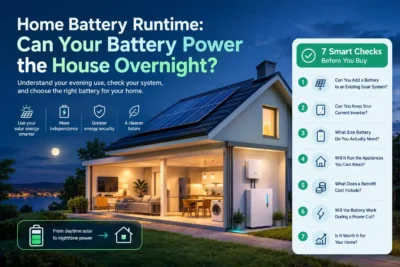
Autonomia della batteria domestica: la tua batteria può alimentare la casa durante la notte?
La durata della batteria domestica dipende da quanta energia utilizzabile hai e da cosa alimenti.

Aggiornamento Batteria Solare: 7 Controlli Intelligenti Prima di Acquistare
Un retrofit di batteria solare significa aggiungere accumulo a pannelli solari che hai già. In molti casi, puoi mantenere

Una batteria domestica da 5kWh è sufficiente? 5 controlli essenziali prima dell'acquisto
Una batteria domestica da 5kWh può coprire un modesto consumo serale di elettricità o mantenere in funzione gli essenziali selezionati durante un'interruzione di corrente. Che
 English
 Polish
 Romanian
 German
 Dutch
 French
 Bulgarian
 Croatian
 Greek
 Czech
 Danish
 Estonian
 Finnish
 Swedish
 Hungarian
 Irish
 Italian
 Latvian
 Lithuanian
 Luxembourgish
 Maltese
 Portuguese
 Slovak
 Slovenian
 Spanish