


When choosing a home battery, most homeowners compare capacity, backup time, cycle life, and solar compatibility. Home battery safety should be part of that decision too.
A properly designed energy storage system uses several layers of protection, including a Battery Management System (BMS), temperature monitoring, electrical protection, a suitable enclosure, and correct installation.
Together, these measures form the basis of home battery fire protection.
Are Home Batteries Safe?
Modern home batteries include multiple safety features, but no energy storage system is completely risk-free.
Battery safety depends on cell quality, battery chemistry, BMS design, temperature control, electrical protection, installation conditions, and proper operation.
Safety is therefore not about one component. It comes from how the complete system works together.
In the U.S., residential energy storage systems may be subject to standards such as UL 9540 and NFPA 855. UL 9540A is used to evaluate thermal runaway and fire propagation in battery energy storage systems.
How Does a BMS Protect a Home Battery?
The Battery Management System (BMS) is a key part of home battery safety.
A BMS monitors conditions such as:
- Cell voltage
- Current
- Temperature
- State of charge
- Cell balance
If operating conditions move outside specified limits, the BMS can activate protection, such as stopping charging or discharging.
For example, BMS protection can respond to overvoltage, undervoltage, excessive current, or abnormal temperature.
A BMS is not a fire suppression system. It is the first layer of protection that helps prevent abnormal battery operation from developing into a more serious problem.
Why Is Thermal Protection Important?
Temperature has a direct impact on battery performance, lifespan, and safety.
Home batteries may be installed in garages, utility rooms, basements, or other areas where temperatures change throughout the year. The battery should always operate within the temperature range specified by the manufacturer.
Excessive heat can accelerate battery degradation and, in severe failure conditions, contribute to thermal runaway.
For this reason, temperature monitoring and thermal protection are important parts of a safe home battery system.
Why Do Home Batteries Need Electrical Protection?
A home battery works together with an inverter, wiring, and other electrical equipment. Circuit breakers, fuses, and disconnect devices help protect the system when abnormal current conditions occur.
They can also make it easier to isolate the battery during maintenance or an electrical fault.
The exact requirements depend on the battery, inverter, system voltage, installation method, and local electrical code.
Good home battery fire protection therefore starts with the complete electrical system, not just the battery pack.
Can a LiFePO4 Battery Catch Fire?
LiFePO4 (lithium iron phosphate) batteries are known for good thermal stability, but they are not completely fire-proof.
Severe electrical faults, physical damage, manufacturing defects, overheating, or improper installation can still create safety risks.
For homeowners, LiFePO4 battery safety depends on more than chemistry. Cell quality, BMS protection, temperature monitoring, electrical protection, and proper installation all matter.
Always follow the manufacturer’s installation and operating instructions.
Does a Home Battery Need Fire Suppression?
Not every home battery requires dedicated fire suppression.
Some energy storage systems may use additional protection, such as aerosol fire suppression, depending on the system design, enclosure, installation location, capacity, and local requirements.
Fire suppression is an additional safety measure. It should not replace BMS protection, electrical protection, proper installation, or appropriate battery design.
UL Solutions’ testing standards also emphasize evaluating the energy storage system and its potential fire behavior rather than relying on a single safety feature.
What Should You Check Before Buying a Home Battery?
Before buying a home battery, look beyond capacity and price. Check:
- Battery chemistry and cell quality
- BMS protection
- Temperature monitoring and thermal protection
- Circuit breakers or disconnects
- Operating temperature range
- Safety certifications and test documentation
- Installation requirements
- Battery and inverter compatibility
In the U.S., requirements can vary by location. Standards such as UL 9540 and NFPA 855 may apply, along with local electrical, building, and fire codes.
If you’re unsure about the requirements, work with a qualified installer and check the rules for your area.
The Bottom Line
Good home battery fire protection is built into the whole system.
Quality cells, a reliable BMS, temperature monitoring, electrical protection, proper installation, and appropriate testing all play a role in home battery safety.
When comparing batteries, don’t look only at capacity, cycle life, or price. Check how the battery handles abnormal conditions and what safety documentation the supplier can provide.
A home battery should not only store energy efficiently. It should also be designed to manage that energy safely.
FAQ
Are home batteries safe?
Modern home batteries use multiple safety measures, including BMS protection, temperature monitoring, and electrical protection. Proper installation is also essential.
Can a LiFePO4 battery catch fire?
LiFePO4 has good thermal stability, but it is not completely fire-proof. Cell quality, BMS protection, temperature control, and proper installation remain important.
What does a BMS do?
A BMS monitors voltage, current, temperature, and cell balance. It can activate protective functions when the battery operates outside its specified limits.
Do home batteries need fire suppression?
Not necessarily. The need for additional fire suppression depends on the battery system, installation environment, enclosure, capacity, and local requirements.
What should I check before buying a home battery?
Check the battery chemistry, cell quality, BMS protection, thermal protection, electrical protection, certifications, installation requirements, and inverter compatibility.
Battery Backup for Refrigerator: What Size Do You Need?
A battery backup for refrigerator use must do two jobs: start the compressor and keep the fridge running through an
LiFePO4 vs Lead Acid for Solar: Is Upgrading Worth It?
Comparing LiFePO4 vs lead acid for solar usually starts with a practical problem: your batteries no longer last through the
Can You Install a Home Battery in an Unheated Garage?
Installing a home battery in a garage can make sense. It keeps the equipment out of your living space, and
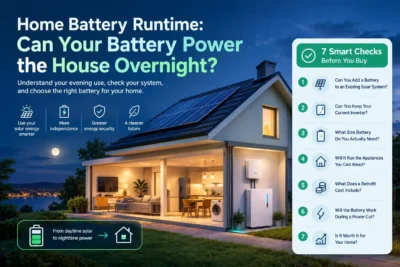
Home Battery Runtime: Can Your Battery Power the House Overnight?
Home battery runtime depends on how much usable energy you have and what you run. A battery may keep the

Solar Battery Retrofit: 7 Smart Checks Before You Buy
A solar battery retrofit means adding battery storage to solar panels you already have. In many cases, you can keep

Is a 5kWh Home Battery Enough? 5 Essential Checks Before Buying
A 5kWh home battery can cover modest evening electricity use or keep selected essentials running during a power cut. Whether
 English
 Polish
 Romanian
 German
 Dutch
Dutch French
 Bulgarian
 Croatian
 Greek
Greek Czech
Czech Danish
 Estonian
 Finnish
 Swedish
 Hungarian
 Irish
Irish Italian
 Latvian
 Lithuanian
 Luxembourgish
 Maltese
 Portuguese
 Slovak
 Slovenian
 Spanish