A 5kWh home battery can cover modest evening electricity use or keep selected essentials running during a power cut. Whether it suits your home depends on your appliances, their running time and the complete system’s capabilities.
The fridge, lights and Wi-Fi might fit comfortably. Add electric heating and an oven, and the battery has a much busier evening ahead.
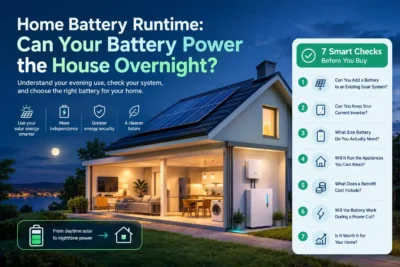
Here are five checks to make before buying.
1. Understand What a 5kWh Home Battery Can Deliver
5kWh describes stored energy. 5kW describes power delivered at one moment.
For example, a kettle drawing 2kW and other appliances drawing 1.5kW need 3.5kW together. A system limited to 3kW cannot support that combination, even with a fully charged battery.
Check the battery’s discharge limit and the inverter’s continuous and starting-power ratings.
Available energy also matters. For this article’s calculation, assume a nominal 5kWh battery, an 80% available energy window and 90% conversion efficiency:
5 × 0.80 × 0.90 = 3.6kWh for appliances
These are planning assumptions, not specifications for every battery. If a manufacturer already states usable capacity, do not subtract the same operating allowance twice.
2. Add Up Your Overnight Essentials
Here is an illustrative eight-hour night:
| Appliance | Assumed consumption | Energy used |
|---|
| Refrigerator | 50W average over 8 hours | 0.40kWh |
| Four LED lights | 8W each for 5 hours | 0.16kWh |
| Wi-Fi router | 10W for 8 hours | 0.08kWh |
| Total | | 0.64kWh |
The refrigerator figure represents an assumed average across its on/off cycles—not its rated power running continuously. Replace it with measured consumption from your own appliance.
Virginia Cooperative Extension’s energy guide explains how to estimate consumption from watts and operating hours.
Under these assumptions, 3.6kWh comfortably covers the listed essentials. But this example excludes cooking, heating, hot water and additional system standby consumption. It is not a measured household or product test.
3. Check Your Expected Battery Runtime
Using the same estimated 3.6kWh available to appliances:
| Combined average load | Estimated runtime |
|---|
| 300W | 12 hours |
| 500W | 7.2 hours |
| 1,000W | 3.6 hours |
| 2,000W | 1.8 hours |
The calculation is available energy divided by average load. It assumes no recharging and excludes additional standby losses, temperature effects and ageing.
A partly charged battery gives you less time. And a runtime calculation does not prove that your inverter can start every appliance.
For outage use, confirm backup capability, switching equipment and supported circuits. Our home battery backup guide explains those requirements.
4. Compare Your Evening Demand With Charging Opportunities
A 5kWh home battery may suit a household using around 3kWh between charging opportunities. If your evening demand is 8kWh, expect it to cover only part of that consumption.
Review several days of smart-meter readings, including days with heavy heating or cooling.
Then check your available solar surplus. A larger battery is useful only when you can charge it and use the extra stored energy.
Ο δικός μας οδηγό μεγέθους οικιακής μπαταρίας μας helps you compare those figures.
How many solar panels do I need to charge a 5kWh battery?
As an example, assume 400W panels, four peak-sun hours and an overall 80% solar-to-stored-energy yield:
0.4kW × 4 hours × 0.80 = 1.28kWh per panel
Four panels could therefore add approximately 5.12kWh under those assumptions. This excludes household consumption during charging.
Peak-sun hours are equivalent full-output hours, not simply daylight hours. Weather, shading, roof direction and charging limits affect results. Four panels are a calculation example, not a guaranteed daily charging solution.
5. Compare the Product and the Complete Cost
Fench Energy’s 51.2V 5.12kWh wall-mounted battery is one option in this capacity class.
| Buying detail | Published specification or calculation |
|---|
| Ονομαστική χωρητικότητα | 5.12kWh, 100Ah |
| Listed SOC range | 15–95% |
| Energy across that range | Approximately 4.10kWh, calculated before conversion losses |
| Maximum continuous discharge current | 100A |
| DC power reference | 51.2V × 100A = 5.12kW at nominal voltage |
| Communication | CAN / RS485 |
The calculated energy is not a tested usable-energy rating. The DC power reference is not guaranteed household AC output. Confirm operating limits and your exact inverter model before ordering.
How much does a 5kWh home battery cost?
On 15 October 2026, the linked product displayed $720 as its Poland warehouse pickup price, excluding delivery.
Your total may also include an inverter, installation, protection equipment, taxes and destination charges. Confirm currency, applicable taxes and delivery costs in your quotation.
Considering a 5kWh home battery? Send Fench Energy your evening consumption, inverter model, essential appliances and postcode. Request a capacity recommendation, compatibility confirmation and a delivered quotation before choosing.





 English
 Polish
 Romanian
 German
 Dutch
 French
 Bulgarian
 Croatian
 Greek
 Czech
 Danish
 Estonian
 Finnish
 Swedish
 Hungarian
 Irish
 Italian
 Latvian
 Lithuanian
 Luxembourgish
 Maltese
 Portuguese
 Slovak
 Slovenian
 Spanish